
The Working Apothecary: Traceability — It’s Not Just for When Something Goes Wrong
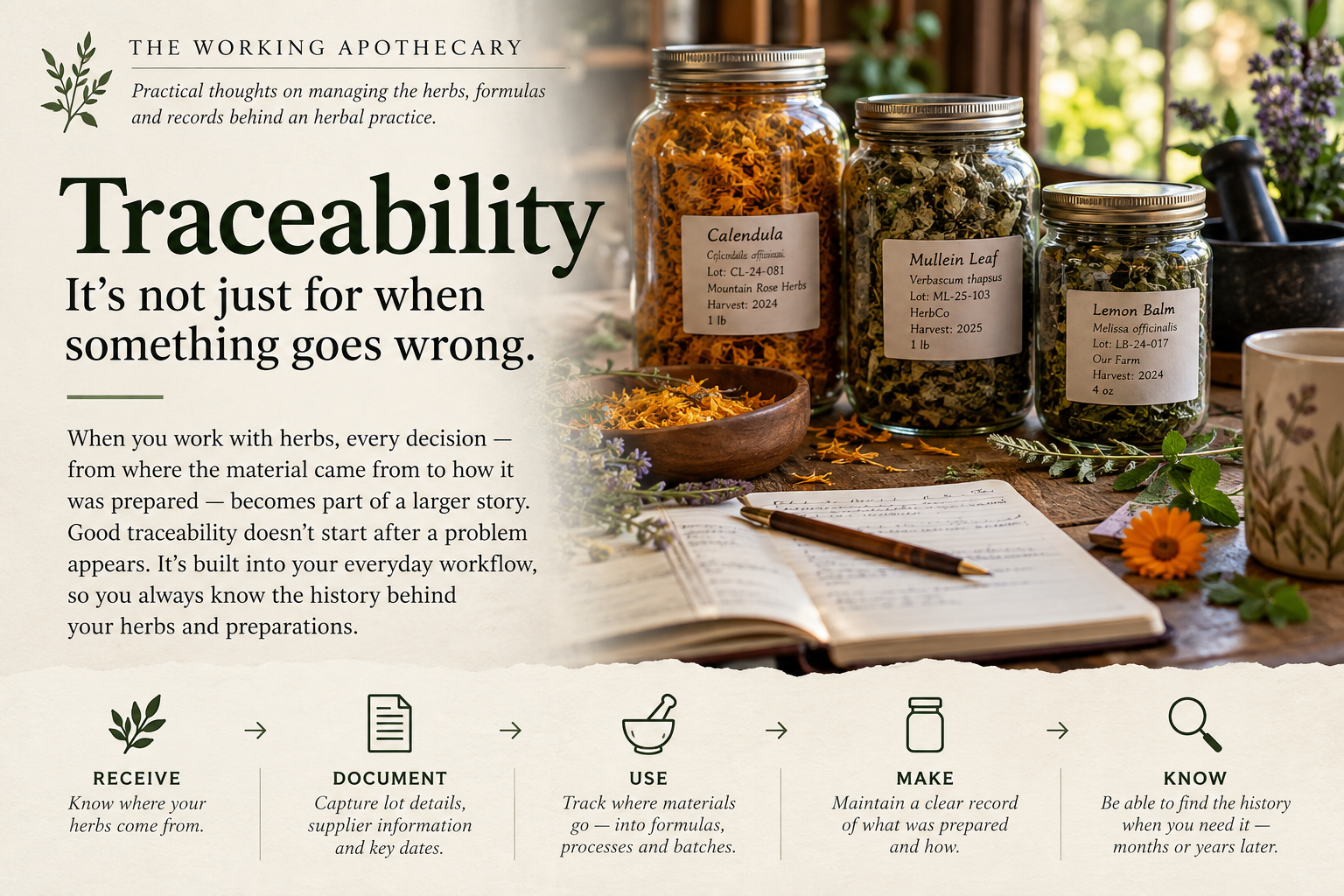
Image by Hilltop Herbals & OpenAI
Imagine opening an email from one of your herb suppliers and learning that there is a problem with a particular lot of an herb you purchased several months ago. You recognize the herb and remember ordering it, but then come the harder questions. Do you still have any of that particular lot? Did you use it in a formula? Was it used in more than one preparation? Have you purchased another lot of the same herb since then? Which finished preparations contain the affected material?
If answering those questions means searching through invoices, jars, notebooks, spreadsheets, email receipts, and handwritten batch records, you may eventually be able to reconstruct the story. But that isn’t really the point of traceability. Good traceability means the story was recorded while it was happening.
Traceability Begins When the Herb Arrives
It’s easy to think of inventory as a list of herbs and quantities: twelve ounces of calendula, eight ounces of mullein leaf, a pound of chamomile. But an herb in a working apothecary has more of an identity than its name and weight. Where did it come from? Who supplied it? When was it received? Does it have a supplier lot number? When was it harvested, if that information is available? Is there an expiration or best-by date? Where is it stored?
There is also an important distinction between the material and the stock you actually have. Two bags of the same herb aren’t necessarily the same stock. You might have mullein leaf remaining from one supplier and then purchase more from another. The two may have different harvest dates, appearances, aromas, cuts, costs, or supporting documentation. Even two purchases from the same supplier may belong to different lots.
Combining everything into a single number—“I have 842 grams of mullein”—may tell you how much mullein you own, but it doesn’t tell you which mullein you have. That distinction is where useful traceability begins.
Follow the Material, Not Just the Quantity
Once an herb enters the apothecary, its story continues. Perhaps some of that mullein becomes part of a respiratory tea blend. Some may be used in a tincture, while another portion eventually goes into an infused oil. A useful record doesn’t simply show that the inventory quantity decreased. It preserves the relationship between the material and what happened to it.
The question then changes from “How much mullein do I have left?” to “Which lot of mullein did I use in this preparation?” Just as importantly, you should be able to turn the question around and ask, “What preparations were made using this particular lot of mullein?”
Both directions matter. You should be able to begin with a finished preparation and trace backward to the materials used to make it. You should also be able to begin with a particular material or lot and trace forward to where it went. That is what makes traceability genuinely useful rather than simply another inventory record.
It Isn’t Only About Recalls
Problems and recalls are obvious reasons for maintaining good records, but they aren’t the only ones. Suppose you make the same formula twice and the second batch tastes noticeably different. Was the formula different? Did something change in your process, or did one of the herbs come from a different lot or supplier?
Perhaps this year’s chamomile is considerably more aromatic than the previous batch. Maybe a particular supplier’s marshmallow root produces a noticeably different extraction. You might open two packages of the same herb and immediately notice differences in color, cut, aroma, or texture. Those observations can become useful information later, especially if you can connect them to the particular stock you were working with.
Good traceability allows you to investigate those differences rather than relying on memory. It can help answer ordinary questions about sourcing, consistency, quality, and technique long before anything actually goes wrong.
The Process Matters, Too
Knowing the identity of the ingredients is only part of the story. How a preparation was made can matter just as much. Depending on what you’re making, useful records might include dates, quantities, stages, duration, measurements, yields, observations, or other details of the process.
The information worth recording will vary depending on the preparation and the scale at which you’re working. The goal isn’t to document things simply for the sake of producing more paperwork. It’s to preserve enough information that months from now, you can understand what you did, what you used, and how you arrived at the finished preparation.
That’s particularly valuable when something turns out exceptionally well. Traceability isn’t only useful for discovering what went wrong. Sometimes you want to know exactly what went right. If a tincture extracts beautifully, a tea blend finally has the balance you’ve been trying to achieve, or a salve reaches exactly the consistency you wanted, good records can help you understand what contributed to that result and make it easier to reproduce.
Don’t Reconstruct the Story Later
One of the weaknesses of many recordkeeping systems is that documentation becomes a separate job. We do the actual work first, and then sometime later we’re supposed to sit down and document what happened. That’s when details get forgotten, lot numbers aren’t recorded, observations end up on scraps of paper, and information that seemed obvious while we were standing at the workbench becomes surprisingly difficult to remember three months later.
A better approach is to make documentation part of the normal workflow. When an herb arrives, record its source and lot information. When you use it, record which stock was used. When you make a preparation, record what went into it and the important details of the process. When the batch is finished, preserve that history with it.
Then, when you need the information later, you don’t have to recreate the trail. The trail already exists.
Start With What You Actually Need
Good traceability doesn’t necessarily require complicated software or an elaborate manufacturing system. A home apothecary, a community herbalist, and a larger herbal products business won’t necessarily need identical records. Your own system might involve a carefully designed notebook, spreadsheets, digital records, or some combination of methods.
What matters is that the information remains connected and retrievable. Can you identify where a particular stock of an herb came from? Can you distinguish between different lots of the same material? Can you determine which materials and lots went into a particular preparation—and, working in the other direction, determine where a particular lot was used? Can you understand how and when a preparation was made? Most importantly, could you still answer those questions six months or a year from now?
If one of those questions makes you think, Well… probably, if I looked around long enough, you’ve just found a place where your recordkeeping could become stronger.
Traceability Should Happen While You Work
There can be a tendency to think of traceability as something formal or complicated, or as something that matters only to large manufacturers. At its heart, though, traceability is much simpler. It’s the ability to tell the story of your materials and preparations: where something came from, what you did with it, what went into a preparation, how it was made, and where it went.
The best systems don’t require you to reconstruct that story from scattered pieces of information months later. They allow the story to build naturally as the work is being done.
The Working Apothecary
Over the coming weeks, we’re going to spend some time looking at the systems behind a working apothecary—the little things that can make managing herbs, formulas, processes, production, and records either much easier or much harder than they need to be.
There’s a reason we’ve been thinking about these things a lot lately.
We’re working on something. We’re not quite ready to tell you everything about it yet, but if you’ve ever wished there were a better way to keep the many moving pieces of an apothecary connected, you may want to follow along. (Beta Testers Wanted)
In the meantime, we’re going to talk about the problems themselves: what works, what doesn’t, and what better apothecary management might look like.
Ancient knowledge deserves thoughtful modern tools.
Kathy is an herbalist/naturopathy practitioner who is constantly researching to expand her knowledge. She came to herbalism after her migraine medicine was suddenly removed from the market and she had to find something new. After discovering the magic of herbs she’s never looked back. She is accredited by the International Practitioners of Holistic Medicine (IPHM) View her courses of study.