
The Working Apothecary: From Formula to Finished Preparation
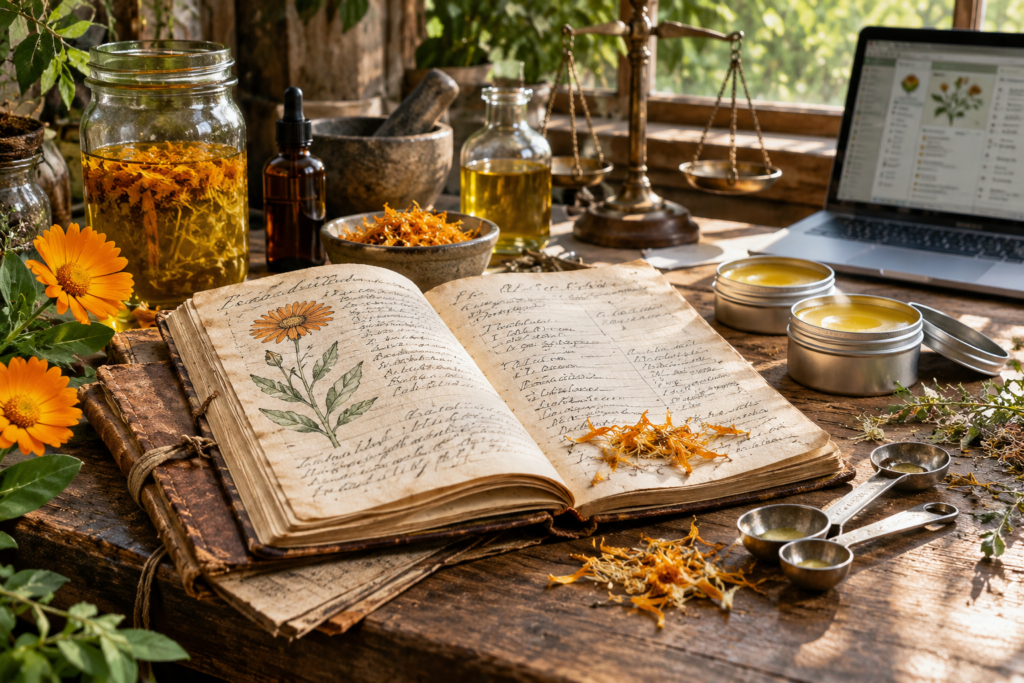
Image by Herbal Journal & OpenAI
The Art and Discipline of Botanical Formulation
There comes a point in every herbalist’s practice when following a recipe is no longer enough. The ingredients may be measured correctly and the instructions carefully followed, but questions begin to emerge. Why was a particular herb selected? Is the extraction method appropriate? Could the preparation be reproduced with consistent results?
These questions mark the transition from following a recipe to understanding formulation.
Traditional herbalism has always relied upon observation, experience, and knowledge of botanical materials. Modern apothecary practices build upon those foundations, bringing greater precision and consistency to the craft without sacrificing its traditional character.
Beyond the Recipe
A recipe tells us what to do. A formula should also explain why.
Consider a simple calendula salve. A recipe might specify calendula-infused oil, beeswax, and the steps required to combine them. A working formula goes further, identifying the botanical material, extraction method, ingredient proportions, and desired characteristics of the finished preparation.
Botanical materials also vary according to growing conditions, harvest timing, processing, and storage. Understanding these differences allows the herbalist to make informed decisions rather than relying solely upon instructions.
Choosing the Right Method
The method of preparation is as important as the ingredients themselves.
Water, alcohol, glycerin, and oil possess different extraction properties. Water readily extracts many polar constituents, while alcohol-water mixtures can extract a broader range of compounds depending on their concentration. Oils are useful for extracting certain fat-soluble constituents, particularly in topical preparations.
An herb traditionally prepared as a decoction may not yield equivalent constituents when infused in oil. Likewise, extending an infusion does not necessarily improve extraction. Time cannot overcome the fundamental limitations of solubility.
Understanding the relationship between botanical constituents, solvents, and preparation methods helps ensure that each technique serves a deliberate purpose.
The Lessons Hidden in Our Notebooks
I learned firsthand how easily valuable formulation knowledge can disappear into the pages of a notebook.
Like many herbalists, I documented my experiments as I worked, recording adjustments, observations, and results. Once I finalized a formula, however, those experimental notes often remained scattered among my notebooks. The finished formula was preserved, but the reasoning, unsuccessful attempts, and small discoveries that led to it were no longer readily accessible.
And sometimes, those seemingly insignificant observations are precisely what we need when revisiting a preparation months or years later.
A formula’s history is as valuable as its final composition. Knowing what didn’t work, and why, can prevent repeated mistakes and provide insight into future improvements.
This experience reinforced the importance of keeping experimentation, formulation, and production records connected rather than treating them as separate activities.
Bringing Knowledge Into the Working Apothecary
This is one of the principles behind RhizoWorks, the apothecary management software I developed to bring the many aspects of herbal practice together.
Rather than allowing experimentation notes to become disconnected from the finished preparation, RhizoWorks provides a structured environment for maintaining research, formulation records, and version histories alongside production activities.
Formulas can evolve without losing earlier versions, while production plans, batch records, and botanical inventory remain part of the same working system. The ability to connect materials, procedures, and finished preparations creates continuity between the herbalist’s original intention and the final result.
The objective is not to replace traditional notebooks or the herbalist’s judgment. It is to preserve the knowledge those notebooks contain and make it accessible when needed.
After all, a formula represents far more than its ingredients. It reflects the experiments, decisions, and experience that shaped it.
The Thinking Herbalist
Good formulation requires more than accurate measurements or meticulous records. It demands botanical knowledge, an understanding of extraction methods, careful observation, and sound judgment.
The herbalist must also consider intended use, potential contraindications, interactions, and the limitations of each preparation.
Traceability establishes the history of our materials. Organization provides structure for the practice. Formulation brings those foundations together at the workbench, where knowledge and experience guide each decision.
A thoughtful formula is not simply a set of instructions to be repeated. It is a living record of understanding, observation, and refinement.
The difference between a recipe and a formula is not simply precision. It is understanding.
The Working Apothecary is an ongoing Herbal Journal series exploring the practical knowledge, methods, and professional considerations involved in maintaining a thoughtful, organized, and responsible herbal practice.
RhizoWorks — Ancient Roots. Modern Practice.
Apothecary management software developed by Hilltop Works, a division of Hilltop Group, LLC.

Kathy is an herbalist/naturopathy practitioner who is constantly researching to expand her knowledge. She came to herbalism after her migraine medicine was suddenly removed from the market and she had to find something new. After discovering the magic of herbs she’s never looked back. She is accredited by the International Practitioners of Holistic Medicine (IPHM) View her courses of study.