
The Working Apothecary: Bringing Order to Herbal Practice
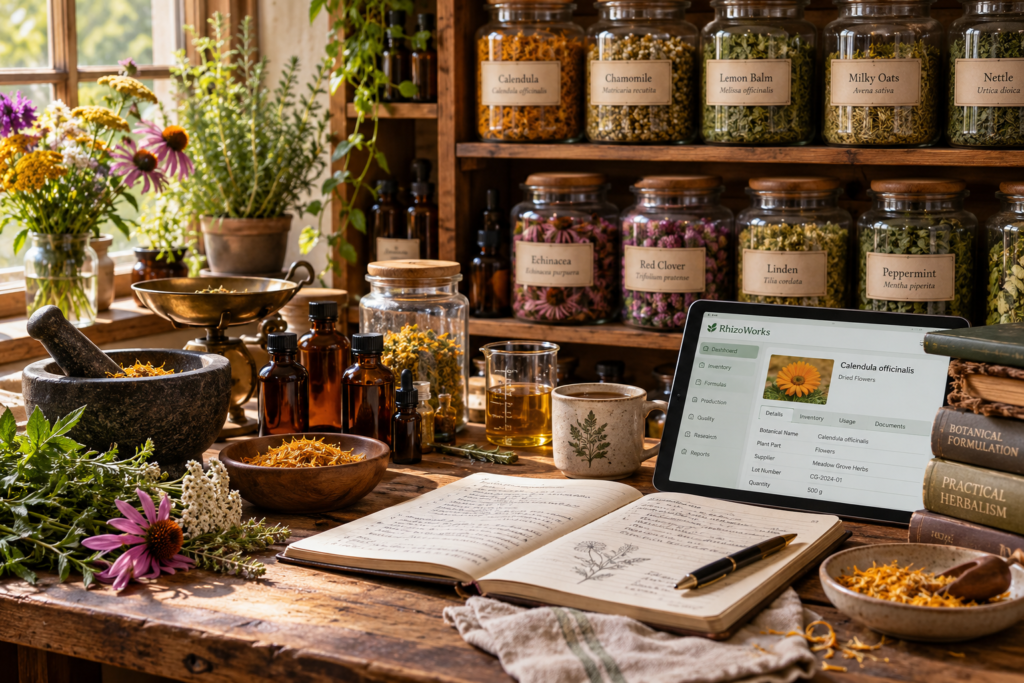
Image by Herbal Journal and OpenAI
From botanical inventory to finished preparations, thoughtful organization is an essential part of a well-managed apothecary.
There is something deeply satisfying about a well-kept apothecary. Carefully labeled jars, the familiar aromas of dried botanicals, tinctures resting in their designated places, and the quiet assurance that everything is where it belongs.
But behind those shelves lies another side of herbal practice: the everyday responsibility of managing an apothecary.
Whether working from a small home collection or a professional herbal workspace, the herbalist must manage materials, maintain formulas, document preparations, monitor quality, and keep accurate records.
A successful apothecary is more than an organized collection of herbs. It is a working system that supports consistency, accountability, and the practice of herbalism itself.
Organization Beyond the Shelves
The physical arrangement of an apothecary should reflect how the herbalist works.
Frequently used botanicals should be accessible, materials requiring particular storage conditions should have appropriate designated spaces, and equipment and packaging supplies should be easy to locate.
An effective inventory system extends that organization beyond the shelves.
Each botanical or ingredient should have a record identifying its botanical name, plant part, supplier, lot number, quantity, storage location, and relevant dates.
Different lots of the same botanical should remain distinguishable, even when stored in the same general area. Their origins, harvest conditions, and supporting documentation may differ.
As materials are received, used, moved, or discarded, inventory records should reflect those changes.
The objective is simple: to know what is available, where it is located, and how it has been used.
From Formulas to Finished Preparations
Formulation is both a creative and disciplined aspect of herbal practice.
Whether following a traditional preparation method or developing an original blend, maintaining accurate formula records supports consistency and thoughtful refinement.
A formula should identify ingredients, proportions, preparation methods, and relevant observations. When adjustments are made, preserving earlier versions allows the herbalist to understand how a preparation has evolved.
Production records serve a related but distinct purpose.
While a formula describes what is intended, a production record documents what actually occurred, including the materials and quantities used, processing details, dates, and finished results.
Together, these records support repeatability, quality evaluation, and traceability from botanical material to finished preparation.
Quality in Everyday Practice
Quality management is not reserved for large manufacturers. It begins with the routine decisions made in every working apothecary.
Incoming botanicals should be examined for identity, condition, and suitability. Storage containers should be properly labeled, equipment maintained, and preparation areas kept clean and orderly.
Supplier documentation, certificates of analysis when available, inspection notes, and equipment maintenance records all contribute to a more dependable practice.
Consistent procedures are equally valuable. Documenting recurring tasks, such as receiving materials, preparing extracts, or packaging finished products, helps reduce omissions and supports reliable results.
The level of documentation will naturally vary between a home herbalist and a commercial operation. Businesses must also consider applicable manufacturing, labeling, and recordkeeping requirements.
Good records support quality, but they do not replace appropriate testing, professional judgment, or regulatory compliance.
Managing the Modern Apothecary
As an herbal practice grows, managing its many responsibilities can become increasingly complicated.
Inventory may live in spreadsheets, formulas in notebooks, production records in binders, and quality documentation in separate folders.
Although each system may serve its purpose, keeping everything connected requires time and attention.
Modern digital tools can simplify this work, particularly when they bring related information together without adding unnecessary complexity.
One such platform is RhizoWorks™, developed specifically to support the organizational and management needs of herbal practitioners.
Guided by the philosophy Ancient Roots. Modern Practice., RhizoWorks brings essential apothecary activities into a single environment, including:
- Inventory and lot tracking: Manage botanical materials, quantities, suppliers, and storage locations.
- Formulary management: Create formulas, document revisions, and maintain preparation histories.
- Production and batching: Record preparation activities, ingredient usage, production costs, and completed batches.
- Quality management: Organize certificates, laboratory documentation, equipment records, and related information.
- Processes and procedures: Maintain documented workflows that support consistency and repeatability.
- Research and professional development: Organize notes, credentials, continuing education, and reminders.
Rather than replacing traditional herbal knowledge, RhizoWorks is designed to support it by making documentation, traceability, and everyday management more accessible.
Currently in beta development, the platform reflects a practical approach to modern apothecary management: helping herbalists spend less time searching for information and more time practicing their craft.
Learn more at RhizoWorks.net.
A Practice Built on Intention
The traditional apothecary has always represented a meeting place between botanical knowledge and practical skill.
Its enduring value lies not simply in shelves of herbs and amber bottles, but in the attention given to the materials, methods, and preparations entrusted to the herbalist.
Thoughtful organization, accurate records, consistent processes, and appropriate quality practices are expressions of that same care.
Whether maintained through handwritten journals or supported by modern tools such as RhizoWorks, a well-managed apothecary allows the herbalist to work with greater confidence, clarity, and purpose.
After all, the purpose of good apothecary management is not to create more paperwork. It is to create more room for the practice of herbalism.

Kathy is an herbalist/naturopathy practitioner who is constantly researching to expand her knowledge. She came to herbalism after her migraine medicine was suddenly removed from the market and she had to find something new. After discovering the magic of herbs she’s never looked back. She is accredited by the International Practitioners of Holistic Medicine (IPHM) View her courses of study.