
When “Natural” Doesn’t Mean Safe
Images created by Herbal Journal & OpenAI
Herbs, Contraindications & the Changing Meaning of GRAS
Herbal medicine has a language problem, especially in the US.
We use words such as natural, traditional, gentle, and safe so frequently that it’s easy for them to begin sounding as though they mean the same thing.
They don’t.
An herb can have hundreds of years of traditional use and still be inappropriate for a particular person. An herb can be perfectly reasonable in a cup of tea and inappropriate as a highly concentrated extract. Something considered safe as a food ingredient isn’t automatically safe at medicinal doses.
And an herb doesn’t stop being capable of causing an adverse reaction simply because it grew in the ground.
None of this is an argument against herbal medicine. Quite the opposite.
Responsible herbalism means respecting the fact that plants can have real physiological effects.
If an herb is powerful enough to help us, it is powerful enough to deserve our attention.
GRAS: What Does It Actually Mean?
You’ll sometimes see herbs, botanical ingredients, and other substances described as GRAS — Generally Recognized as Safe.
It’s easy to read those words and assume they mean:
“The FDA tested this and determined that it is safe.”
That’s not necessarily what GRAS means.
GRAS is part of federal food law. It concerns whether qualified experts generally recognize a substance as safe under the conditions of its intended use in food.
That last part matters.
GRAS is not a universal declaration that a substance is harmless. It doesn’t mean unlimited amounts are safe. And it isn’t a blanket FDA approval of an herb for medicinal use.
Historically, companies have also been able to reach their own GRAS conclusions without being required to notify FDA.
That system is now under scrutiny.
In 2026, FDA has identified as one of its Human Foods Program priorities a proposed regulation that would require companies to submit GRAS notices for all new substances claimed to be GRAS.
That is an important change to watch.
But it also gives us an opportunity to have a much larger conversation about what the word safe means in herbal medicine.
GRAS Isn’t the Same Thing as FDA Approval
This distinction is especially important when we’re talking about herbal supplements.
Dietary supplements are not FDA-approved for safety and effectiveness before they reach store shelves in the way prescription medications are.
Manufacturers and distributors have the initial responsibility for making sure their dietary supplements meet applicable safety requirements.
FDA can—and does—take action when safety problems arise, but much of that authority operates after products have entered the marketplace.
So when you see an herbal supplement sitting on a store shelf, its presence there shouldn’t automatically be interpreted as:
“The FDA determined that this product is safe and effective.”
It didn’t.
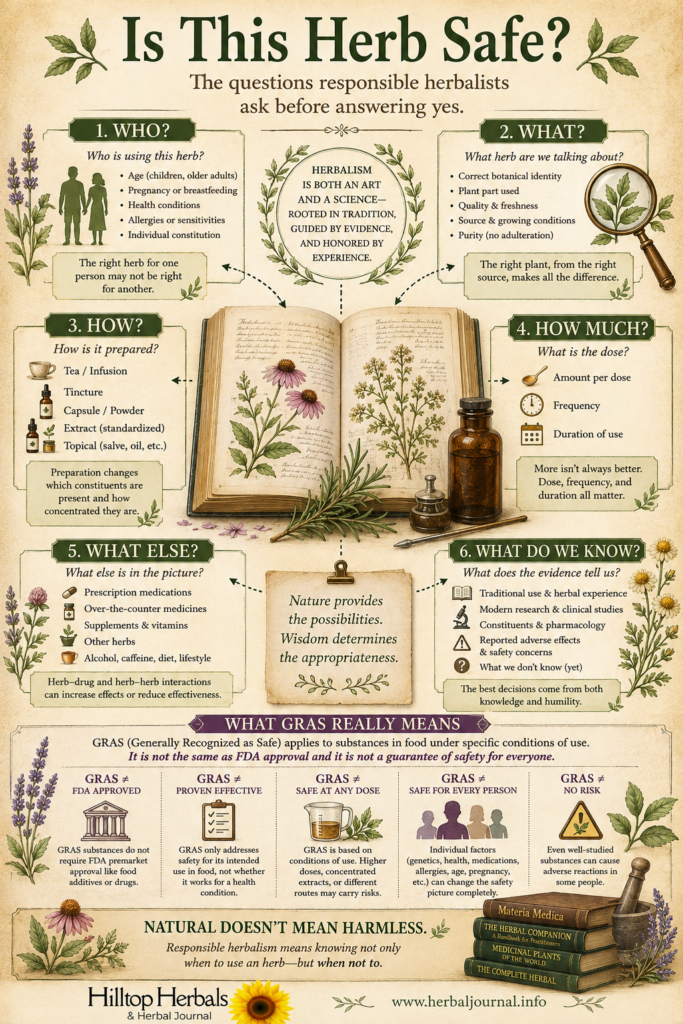
Natural Doesn’t Mean Harmless
There is nothing inherently frightening about this.
Plants contain biologically active compounds. That’s one of the reasons herbal medicine exists.
But those compounds don’t somehow know whether we’re calling them food, medicine, tea, supplement, or natural.
They interact with human physiology.
Sometimes that’s precisely what we’re looking for.
Sometimes it isn’t.
A good example is St. John’s wort (Hypericum perforatum). It’s a valuable medicinal plant, but it is also well known for interacting with numerous medications and potentially changing how effectively those medications work.
That doesn’t make St. John’s wort a “bad herb.”
It makes it an herb we need to understand before using it.
The Dose Changes the Conversation
There’s another distinction that frequently disappears online:
A culinary amount is not necessarily a medicinal amount.
Think about herbs we routinely encounter in food.
A sprinkle of an herb in dinner, a cup of herbal tea, several capsules of powdered herb, a concentrated tincture, and a standardized extract aren’t interchangeable simply because they came from the same plant.
Extraction methods can change which constituents are present and how concentrated they become.
Dose changes exposure.
Frequency changes exposure.
Duration changes exposure.
This is why saying “people have eaten this plant for centuries” doesn’t automatically answer a safety question about taking a concentrated extract several times a day for six months.
Context matters.
Contraindications Aren’t Fine Print
When I write about herbs, you’ll notice that I spend quite a bit of time discussing contraindications.
There’s a reason for that.
A contraindication doesn’t necessarily mean an herb is dangerous.
It means there are circumstances in which that herb may not be appropriate—or circumstances that deserve additional consideration.
Those can include:
- Pregnancy and breastfeeding
- Childhood or advanced age
- Kidney or liver impairment
- Cardiovascular conditions
- Upcoming surgery
- Allergies
- Prescription medications
- Other supplements
- Dose and duration of use
And sometimes the answer simply isn’t known.
That’s important information too.
“We don’t have enough evidence to know” is a perfectly legitimate answer in herbal medicine.
Herb–Drug Interactions Are Real
This is one of the areas where responsible herbalism becomes particularly important.
An herb doesn’t necessarily have to make a medication more toxic to cause a problem.
It might make the medication work more strongly.
Or it might make the medication work less effectively.
That distinction is important.
If an herb increases the effect of something that already lowers blood pressure, blood glucose, clotting, or sedation, the combined effect may become greater than intended.
Other herbs can affect enzymes or transporters involved in the way medications are absorbed or metabolized.
That’s why the question shouldn’t simply be:
“Is this herb safe?”
A better question is:
“Is this herb appropriate for this person, in this preparation, at this dose, alongside everything else they’re taking?”
That’s a very different question.
Allergies and Individual Reactions Still Matter
Even an herb with an excellent safety history can cause an adverse reaction in an individual.
People can be allergic to plants.
They can react to particular botanical families.
They can tolerate one preparation but not another.
And occasionally someone experiences a reaction that simply isn’t typical.
That doesn’t necessarily prove that the herb itself is broadly unsafe.
But neither should an unusual reaction be dismissed because an herb is “natural.”
Our bodies don’t read herbal monographs.
Individual responses matter.
A Real-World Example: Andrographis in Australia
A recent example from Australia shows why herbal safety deserves ongoing attention—even when a plant has a history of medicinal use.
Andrographis paniculata, sometimes called andrographis or king of bitters, is an herb with a long history of traditional use and is commonly found in herbal products marketed for immune and respiratory support.
But Australia’s Therapeutic Goods Administration (TGA) has been monitoring reports of serious allergic reactions associated with medicines containing andrographis.
Following a safety review, Australian regulators concluded that medicines containing Andrographis paniculata carry a rare but unpredictable risk of severe allergic reactions, including anaphylaxis. Reports included reactions occurring in people who had previously taken andrographis without a problem.
That last point is particularly important.
Previous tolerance doesn’t guarantee that an allergic reaction cannot occur later.
This doesn’t mean andrographis suddenly became a “bad herb,” nor does it erase its history of traditional use. It means that continued monitoring revealed a risk that consumers and practitioners need to know about.
And that’s exactly what responsible herbal medicine should do when new safety information emerges: we update what we know.
Traditional knowledge matters. Modern research matters. Adverse-event reporting matters. And none of them need to invalidate the others.
The lesson isn’t “herbs are dangerous.”
The lesson is much simpler:
Even a useful herb may not be the right herb for every person.
Traditional Use Matters—But It Isn’t the Whole Story
As an herbalist, I value traditional knowledge enormously.
Generations of observation from herbalists all over the world teach us things that cannot simply be discarded because they didn’t originate in a modern clinical trial.
But traditional use and modern research don’t have to be enemies.
They answer different questions.
Traditional knowledge may tell us how people have used a plant, how it was prepared, and what practitioners observed over generations.
Modern research may help us understand constituents, pharmacology, interactions, toxicity, dosing, and mechanisms that earlier herbalists couldn’t measure.
Good herbalism can listen to both.
Perhaps We Need a Better Definition of “Safe”
Instead of asking whether an herb is simply safe or unsafe, perhaps we should think about several different questions:
Is it traditionally used?
Is there evidence supporting the intended use?
What preparation are we talking about?
At what dose?
For how long?
What medications or supplements is the person already taking?
Are there medical conditions that change the risk?
Are there known contraindications?
And what don’t we know yet?
That’s a much less exciting answer than a green label declaring something 100% NATURAL!
But it’s a much more useful one.
Respect the Herb
I don’t want people to be frightened of herbs.
I want people to respect them.
Herbal medicine has been part of human health care for thousands of years. Plants have given us food, medicine, comfort, and some of the compounds that eventually became modern pharmaceuticals.
But appreciating herbal medicine doesn’t require pretending that every plant is appropriate for every person.
Quite the opposite.
Knowing when not to use an herb is every bit as much a part of herbalism as knowing when to use one.
The changing conversation surrounding GRAS gives us a timely reminder of something herbalists have understood for generations:
Safety isn’t just about the name of the plant.
It’s about the plant, the preparation, the dose, the person—and the circumstances in which it’s being used.
That’s not a weakness of herbal medicine.
That’s what responsible herbal medicine looks like.
Thanks for reading – download our Infographic!
Kathy McCabe
Kathy is an herbalist/naturopathy practitioner who is constantly researching to expand her knowledge. She came to herbalism after her migraine medicine was suddenly removed from the market and she had to find something new. After discovering the magic of herbs she’s never looked back. She is accredited by the International Practitioners of Holistic Medicine (IPHM) View her courses of study.