
What Happened When We Moved Indoors?
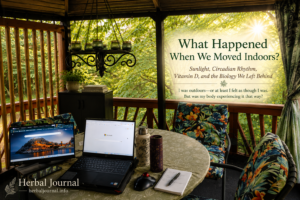
Kathy’s Treehouse Office with editing assist from OpenAI
Sunlight, Circadian Rhythm, Vitamin D, and the Biology We Left Behind
This morning, I’m working from my Treehouse Office.
The trees surround me. Morning light fills the space, and birds move through the branches outside the windows. From where I sit, it feels very much as though I am spending my morning in nature.
And then I had a thought:
I was outdoors—or at least I felt as though I was. But was my body experiencing it that way?
For most of human history, daylight wasn’t something people deliberately added to a wellness routine. Our ancestors didn’t set reminders to “get morning light.” They lived their days largely according to the rising and setting of the sun.
Today, many of us wake indoors, work indoors, travel inside vehicles, shop indoors and spend our evenings under artificial light.
We may see the sun through a window every day without actually spending much time outside.
What has that change meant for our biology?
Our Bodies Still Expect Day and Night
Deep within the brain is a master biological clock called the suprachiasmatic nucleus (SCN). Light entering our eyes helps this clock determine when it is daytime and when it is nighttime.
That timing influences far more than sleep.
Circadian rhythms help coordinate hormone release, body temperature, appetite, digestion and many other physiological processes. Nearly every tissue and organ in the body operates according to biological rhythms.
Morning light helps signal that the biological day has begun. As darkness arrives in the evening, melatonin normally rises, helping signal that it is time for the body to prepare for sleep.
Modern life hasn’t removed this ancient system.
We’ve simply become very good at confusing it.
Instead of bright days followed by dark nights, many of us experience relatively dim indoor days followed by brightly illuminated evenings.
Perhaps the question isn’t simply whether we’re sleeping enough.
It might also be:
Does my body clearly know when it’s daytime and when it’s nighttime?
Sitting in Sunshine Isn’t Necessarily Being in Sunshine
That brings me back to my Treehouse Office.
Being surrounded by windows gives me plenty of visible daylight. That light can contribute to the signals my eyes send to my circadian system.
But there is another reason humans have a particularly interesting relationship with sunlight: vitamin D.
When UVB radiation reaches exposed skin, it begins a process that allows our bodies to produce vitamin D₃.
Ordinary window glass, however, blocks most UVB.
So although I can sit in a beautiful patch of sunlight beside a window, that isn’t the same as stepping outside and allowing sunlight to reach my skin.
It illustrates an important distinction:
Seeing daylight, receiving circadian light signals and producing vitamin D are related—but they aren’t the same thing.
The Sunshine Vitamin
Vitamin D is best known for supporting calcium absorption and healthy bones, but it also has important roles in normal muscle, nerve and immune function.
We can obtain vitamin D through certain foods and supplements, but sunlight remains unusual because our bodies can actually manufacture vitamin D when appropriate UVB reaches the skin.
That doesn’t mean we should simply spend as much time in the sun as possible.
How much vitamin D someone’s skin can produce varies enormously with season, latitude, time of day, age, skin pigmentation, clothing and other factors.
And UV exposure can damage skin.
Recognizing sunlight as biologically important doesn’t require pretending sunburn is healthy.
More isn’t automatically better.
Our goal doesn’t need to be tanning or prolonged UV exposure. It can simply begin with recognizing that spending time outdoors is biologically different from looking at the outdoors through a window.
Can We Just Take a Supplement?
Sometimes vitamin D supplementation is entirely appropriate.
But a vitamin D capsule isn’t a replacement for daylight any more than daylight is a replacement for adequate nutrition.
A supplement can provide vitamin D.
It cannot provide morning light to the eyes. It cannot tell our biological clock that a new day has begun. It doesn’t create the gradual transition from daylight into evening darkness.
The opposite is also true: spending time outdoors doesn’t guarantee that everyone will maintain adequate vitamin D levels.
Rather than choosing between sunlight and supplements, a more useful approach is to understand what each provides.
And supplements deserve the same respect we give medicinal herbs.
Vitamin D is fat-soluble, and excessive supplementation can be harmful. “Available over the counter” does not mean “take as much as you like.”
The same principle applies in herbalism.
Natural doesn’t mean unlimited.
Where Do Herbs Fit?
There are herbs traditionally used to support relaxation and sleep—chamomile, passionflower, valerian and others.
They can have a useful place.
But here’s where our understanding of circadian rhythm changes the conversation.
If someone is spending the entire day indoors, receiving little outdoor daylight and then sitting beneath bright lights and screens late into the evening, is another nighttime supplement always the first thing the body needs?
Perhaps not.
An evening herb may help someone relax, but it can’t create darkness.
A morning supplement can’t reproduce morning daylight.
Sometimes supporting the body means adding something.
Sometimes it means restoring something that is missing.
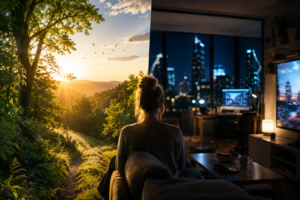
Image by Herbal Journals & OpenAI
Maybe We Haven’t Lost the Sun—We’ve Lost Contrast
This may be the part of circadian biology I find most interesting.
Our ancestors experienced bright days and genuinely dark nights.
Modern humans can experience the opposite: relatively dim days indoors and surprisingly bright nights.
We keep our homes at comfortable temperatures throughout the seasons. Food is available whenever we want it. Screens keep our brains engaged long after sunset.
None of those things makes modern life inherently unhealthy.
But our biological clocks developed long before electric lights, climate control and smartphones.
Perhaps we haven’t simply lost sunlight.
We’ve lost some of the contrast between day and night.
And restoring a little of that contrast doesn’t require rejecting modern life.
It might mean stepping outside for a while after waking.
Taking lunch outdoors.
Going for a walk during daylight.
Allowing the house to become a little dimmer as evening approaches.
Keeping the bedroom dark.
And occasionally remembering that seeing nature through a window isn’t quite the same as experiencing it.
Sometimes the Most Natural Remedy Isn’t an Herb
As an herbalist, it’s easy to look at a symptom and begin thinking about plants.
Trouble sleeping? Which herb?
Low energy? Which herb?
Stress? Which herb?
There is certainly a place for medicinal plants. But good herbalism has never simply been about matching an herb to a symptom.
It’s about asking what the body needs.
Sometimes that may be a medicinal plant.
Sometimes it’s better nutrition.
Sometimes it’s movement or rest.
Sometimes supplementation is appropriate.
And sometimes the answer may be something our ancestors never needed to put on a wellness checklist:
Go outside while it’s daytime.
Which brings me back to where I started.
I’m sitting in my Treehouse Office, surrounded by trees and morning light. It feels like I’m outside.
But my body knows the difference.
Maybe it’s time to close the laptop for a few minutes and step beyond the window.
This article is for educational purposes and is not intended to replace individualized medical advice. Vitamin D supplementation and herbal products can interact with medications or be inappropriate for some health conditions. Discuss significant supplementation or suspected deficiency with an appropriate health-care professional.
Further Reading
National Institute of General Medical Sciences — Circadian Rhythms
NIH Office of Dietary Supplements — Vitamin D Fact Sheets
National Heart, Lung, and Blood Institute — Circadian Rhythm Disorders
National Center for Complementary and Integrative Health — Melatonin: What You Need to Know
Endocrine Society — Vitamin D for the Prevention of Disease Clinical Practice Guideline
Kathy is an herbalist/naturopathy practitioner who is constantly researching to expand her knowledge. She came to herbalism after her migraine medicine was suddenly removed from the market and she had to find something new. After discovering the magic of herbs she’s never looked back. She is accredited by the International Practitioners of Holistic Medicine (IPHM) View her courses of study.