
How to Read Herbal Supplement Labels Beyond Milligrams
Walk down any supplement aisle and you’ll find dozens of herbal products promising similar benefits. Many display large numbers on the front of the bottle, making it easy to assume that a higher number automatically means a stronger or better product. In reality, those numbers may be measuring entirely different things.
I wanted to share this article because it highlights an issue that deserves more attention. As consumers, we’re becoming increasingly aware of ingredient sourcing, transparency, and quality, yet many of us have never been taught how to interpret the language used on supplement labels. This article offers a practical look at what terms like extract ratios, standardization, and herb equivalents actually mean and why understanding them matters when comparing products.
Enjoy! ~Kathy
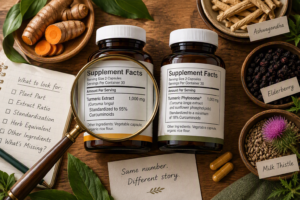
Image by Herbal Journal and Copilot
By Gleb Verdi
Two turmeric supplements from the same manufacturer listed 1,000 mg per two-capsule serving. One specified a turmeric extract standardized to 95% curcuminoids. The other listed a preparation combining extract with sunflower phospholipids, standardized to a minimum of 18% curcuminoids. Matching the serving size and the milligrams had not produced a like-for-like comparison. [1]
For anyone familiar with herbal preparations, the underlying distinction is not new. A dried root, a tincture and a concentrated extract may come from the same plant, but they are not interchangeable preparations. Yet on commercial supplement labels, the shared language of milligrams can make those differences surprisingly easy to overlook.
These Doctor’s Best products were among 40 formulations examined in a September 2026 label review conducted by HerbEra. The review covered publicly available labels and product information across four botanical categories. Ten products were selected from each of four iHerb categories: ashwagandha, turmeric, milk thistle and elderberry. HerbEra’s own products were excluded.
An identifiable amount per serving was available for 39 products, whether for the botanical preparation, a named extract-carrier complex or a stated herb equivalent. The remaining case involved conflicting source descriptions. The more revealing work began after locating the amount: identifying what it measured. [1]
What sits inside the number
In the turmeric comparison, the Phytosome product’s 1,000 mg covered the combined preparation, including its carrier. Its declared minimum of 180 mg curcuminoids was contained within that weight. Adding the two numbers would count the curcuminoids twice. [1]
This is one reason the arrangement of an ingredient entry deserves attention. FDA guidance allows constituents to be listed beneath their parent ingredient, with their own amounts. Those indented lines can describe parts of the ingredient above them, rather than additional ingredients to total up. [2]
Both turmeric products supplied useful detail. The audit could distinguish their declared compositions, but could not establish which would perform better. A percentage describes a proportion of the named preparation, not a clinical result. [1, 5]
The distinction can occur within one capsule, too. A Swanson milk thistle product listed 250 mg of seed extract standardized to 80% silymarin alongside 250 mg of seed powder. Calling this simply 500 mg of milk thistle would lose the separation the manufacturer had supplied. The 80% specification belonged to the extract line, not to the combined weight. [1]
The plant part comes first
Before comparing percentages, it helps to establish which plant material entered the preparation. Nutricost’s KSM-66 ashwagandha listed 600 mg of root extract per capsule. Life Extension’s Optimized Ashwagandha listed 125 mg of a root-and-leaf extract per capsule. Both identified Withania somnifera, but their ingredient descriptions did not identify the same starting material. [1]
That difference has a botanical basis. The NIH Office of Dietary Supplements explains that ashwagandha root and leaf differ in chemical composition. Recording the plant part therefore preserves information that a common name and weight alone cannot supply. It does not justify deciding that one part is universally better. [3]
Preparation adds another distinction. In the milk thistle example, the powder was ground seed, while the extract represented material obtained through extraction. Extraction uses a solvent to dissolve constituents from the plant; the resulting material may remain liquid or be dried. A dried extract can itself be a powder, so powder as a physical description does not always establish how an ingredient was made. The distinction is between ground plant material and extracted material, not simply between a powder and a liquid. [1, 4, 5]
What an herb equivalent leaves unanswered
Another sampled milk thistle product, from Nutricost, listed 250 mg of a 4:1 extract, equivalent to 1,000 mg of herb. Here the label supplied the relationship explicitly: the larger number described starting botanical material represented by the extract. It was not another 1,000 mg inside the capsule. [1]
A plant-to-extract ratio describes a manufacturing relationship. It does not provide a complete chemical profile. A technical paper by United States Pharmacopeia specialists explains why extraction solvents, processing conditions and added carriers matter alongside that ratio. Two extracts with matching ratios need not have matching compositions. [5]
The elderberry records offered a useful contrast between kinds of detail. Nature’s Way Sambucus Immune Gummies declared 50 mg of extract from 3,200 mg of elderberries per two-gummy serving. The checked information also described standardization to anthocyanins, but supplied no anthocyanin amount or percentage. The berry equivalent was disclosed; the marker quantity was not. The 50 mg and 3,200 mg figures could not fill in that missing specification. [1]
Where the comparison stops
This was a review of publicly available label information from 40 products listed on iHerb, not a laboratory investigation. The products were selected using predefined criteria, and the findings shouldn’t be treated as representative of the entire supplement market. The review tells us what the labels disclosed, not whether the products contained exactly what they claimed. [1]
The next time two herbal supplements appear to offer the same dose, start with the serving size and read the entire ingredient description. Is the amount referring to ground plant material, an extract, or a preparation that includes an extract and a carrier? Which part of the plant was used? If the label gives an herb equivalent or a standardized constituent amount, keep that information separate from the weight of the preparation itself. These numbers describe different things and should not simply be added together.
Consider the two turmeric products from the beginning. Both declare 1,000 mg per two capsules, but one describes a standardized extract while the other includes a phospholipid-containing preparation. Their curcuminoid specifications provide further information, yet neither label alone tells us which product would perform better. The useful habit is to ask what each number actually measures, what preparation it describes, and what remains unknown. Sometimes the most important part of reading a label is recognizing what it doesn’t tell you.
 About the author
Gleb Verdi writes educational content about botanical ingredients and supplement labeling for HerbEra.
Sources:
[1] Original research. HerbEra. 40-Product Herbal Supplement Label Review, September 29, 2026. AI-assisted desk audit of publicly available product labels across four botanical categories. This was not laboratory or clinical research. Full analysis: How to Read Herbal Supplement Labels. Supporting label records and methodology are available upon editorial request.
[2] U.S. Food and Drug Administration. Dietary Supplement Labeling Guide, Chapter IV: Nutrition Labeling, question 33 (constituents listed beneath a dietary ingredient).
[3] NIH Office of Dietary Supplements. Ashwagandha: Fact Sheet for Health Professionals, Introduction (root and leaf composition).
[4] NIH Office of Dietary Supplements. Botanical Dietary Supplements: Background Information (preparation, standardization and quality).
[5] Monagas M, et al. (2022). Understanding plant to extract ratios in botanical extracts. Frontiers in Pharmacology, 13:981978. doi:10.3389/fphar.2022.981978.
Kathy is an herbalist/naturopathy practitioner who is constantly researching to expand her knowledge. She came to herbalism after her migraine medicine was suddenly removed from the market and she had to find something new. After discovering the magic of herbs she’s never looked back. She is accredited by the International Practitioners of Holistic Medicine (IPHM) View her courses of study.