
Herbal Support for Sprains, Strains, and Muscle Spasms
Herbal Support for Sprains, Strains, and Muscle Spasms
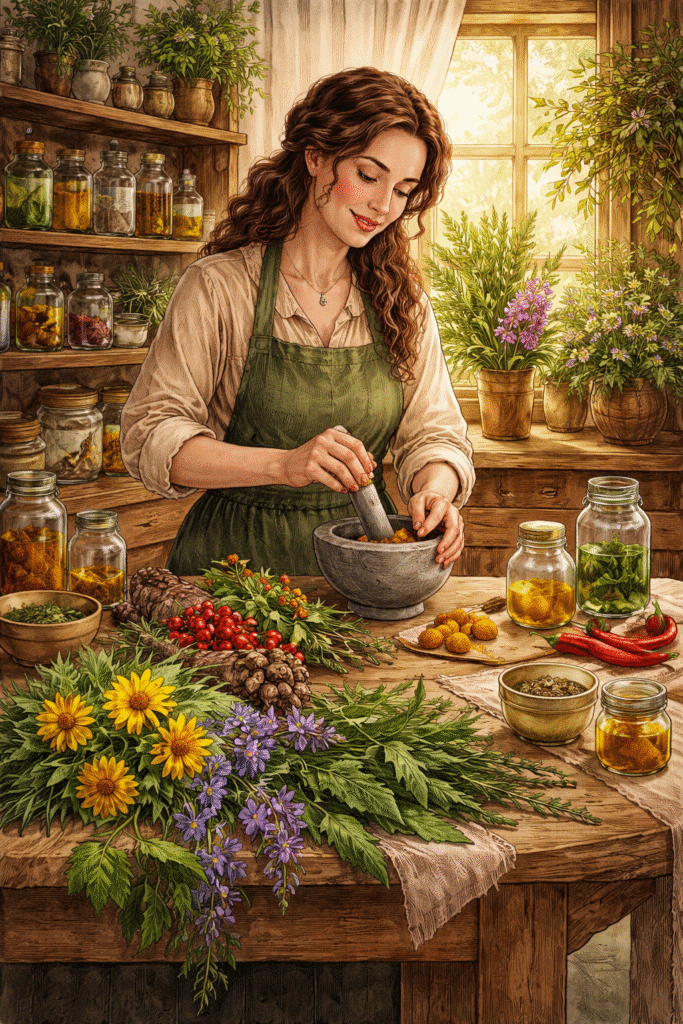
Image by Kathy McCabe & OpenAI
Muscle spasms, ligament sprains, and muscle or tendon strains are some of the most common musculoskeletal injuries. Whether caused by lifting, sudden movement, athletic activity, or simple overexertion, these injuries share a common pattern: inflammation, tissue stress, and protective muscle tightening.
A back spasm often accompanies a strain or sprain as the body tries to stabilize the injured area. While rest, gentle movement, and appropriate medical care are important, herbal medicine can play a supportive role by helping to:
- Reduce inflammation
- Ease muscle tension
- Improve circulation to injured tissues
- Support connective tissue recovery
Below are several herbs commonly used by herbalists to support healing from muscle spasms, sprains, and strains.
Arnica (Arnica montana)
 Image by Kathy McCabe & OpenAI |
 Image by Kathy McCabe & OpenAI |
Arnica is one of the most widely used herbs for trauma and soft tissue injury.
Actions
- Anti-inflammatory
- Analgesic
- Circulatory stimulant (topical)
How it helps
Arnica is particularly useful for:
- Muscle strains
- Ligament sprains
- Bruising
- Overworked muscles
- Impact injuries
Topical arnica preparations may help reduce swelling and discomfort in injured tissues.
Common preparations
- Arnica salves
- Infused oils
- Creams
- Compresses
⚠️ Arnica should generally be used topically only, unless in homeopathic form.
Cramp Bark (Viburnum opulus)
 |
 |
Cramp bark is a classic antispasmodic herb used for involuntary muscle contractions.
Actions
- Antispasmodic
- Mild analgesic
- Nervine relaxant
How it helps
While often associated with menstrual cramps, cramp bark is also helpful for:
- Back spasms
- Neck tension
- Muscular guarding around sprains or strains
When ligaments or muscles are injured, surrounding muscles often tighten to protect the area. Cramp bark helps ease that protective spasm.
Common preparations
- Tincture
- Bark decoction
Turmeric (Curcuma longa)
 |
 |
Turmeric has become one of the most widely researched herbal anti-inflammatory agents.
Actions
- Anti-inflammatory
- Antioxidant
- Circulatory stimulant
How it helps
Sprains and strains involve micro-tears in muscles or ligaments, which trigger inflammation during the healing process. Turmeric’s curcuminoids may help modulate inflammatory pathways and support recovery.
Common preparations
- Capsules
- Tincture
- Golden milk or herbal teas
Combining turmeric with black pepper improves absorption.
Skullcap (Scutellaria lateriflora)
 |
 |
American skullcap is a gentle but effective nervine relaxant.
Actions
- Nervine
- Antispasmodic
- Mild sedative
How it helps
In injuries like sprains and strains, pain can create a cycle of muscle guarding and tension. Skullcap helps relax the nervous system and can reduce the tendency toward ongoing muscle tightness.
This can be especially helpful when spasms are worsened by stress or fatigue.
Common preparations
- Fresh plant tincture
- Infusion
Comfrey (Symphytum officinale)
 |
 |
Comfrey has long been used in traditional herbal medicine for supporting tissue repair.
Actions
- Tissue restorative
- Anti-inflammatory
- Demulcent (topical)
How it helps
Comfrey contains allantoin, a compound associated with cell proliferation and tissue repair. Herbalists often use it externally for:
- Sprains
- Ligament injuries
- Muscle strains
- Bruises
Common preparations
- Comfrey poultices
- Infused oils
- Salves
⚠️ Comfrey should generally be used externally only.
Cayenne (Capsicum spp.)
 |
 |
Cayenne is a warming herb that supports circulation and modulates pain signaling.
Actions
- Circulatory stimulant
- Counterirritant
- Analgesic (capsaicin)
How it helps
Capsaicin reduces certain pain signals in nerve endings and improves circulation to injured areas. Cayenne is often used in topical formulas for:
- Chronic muscle soreness
- Joint pain
- Healing strains
Common preparations
- Capsaicin creams
- Warming oils
- Herbal salves
External Herbal Approaches for Sprains and Strains
Topical herbal treatments can be especially helpful because they act directly on the injured tissues.
Common options
- Arnica oil or salve
- Comfrey poultice
- Cayenne warming salve
- Herbal compresses
Example compress
- Brew a strong tea of ginger or chamomile
- Soak a cloth in the warm infusion
- Apply to the affected area for 15–20 minutes
This helps increase circulation and ease muscle tension.
Internal Herbal Support
Some herbs help the body systemically during recovery.
Useful categories
Anti-inflammatory herbs
- Turmeric
- Ginger
- Boswellia
Antispasmodics
- Cramp bark
- Valerian
- Skullcap
Connective tissue support
- Nettle
- Horsetail
- Oatstraw
These provide minerals that support tissue repair.
Recovery Practices that Complement Herbal Care
Herbs work best when combined with supportive physical care.
Helpful strategies include:
- Rest during the acute phase
- Ice during the first 24–48 hours of acute sprains
- Heat once inflammation begins to subside
- Gentle movement to prevent stiffness
- Gradual stretching after spasms ease
Avoid aggressive stretching during acute injury, which can worsen tissue damage.
Safety Considerations
- Severe pain, numbness, or weakness should be evaluated by a medical professional.
- Persistent sprains or strains may involve ligament tears.
- Some herbs may interact with medications.
Herbal medicine can be a valuable part of a comprehensive approach to musculoskeletal recovery, helping the body calm inflammation, relax muscles, and support tissue repair naturally.
Sources
Bone, K., & Mills, S. (2013). Principles and Practice of Phytotherapy.
Hoffmann, D. (2003). Medical Herbalism: The Science and Practice of Herbal Medicine.
Tilgner, S. (2009). Herbal Medicine from the Heart of the Earth.
National Center for Complementary and Integrative Health (NCCIH)
European Medicines Agency herbal monographs
Kathy McCabe

Kathy is an herbalist/naturopathy practitioner who is constantly researching to expand her knowledge. She came to herbalism after her migraine medicine was suddenly removed from the market and she had to find something new. After discovering the magic of herbs she’s never looked back. She is accredited by the International Practitioners of Holistic Medicine (IPHM) View her courses of study.