
Chickweed: The Quiet Healer of Spring
I keep coming back to chickweed; it’s my favorite herb. Chickweed isn’t flashy. It doesn’t demand attention. It simply shows up, quietly, offering exactly what is needed.
In a world where so many systems are overstimulated, overheated, and overwhelmed, chickweed reminds us that healing doesn’t always have to be intense.
Sometimes, it’s as simple as stepping outside, gathering a handful of green, and letting the body soften back into balance.
Stellaria media and the Art of Gentle Cooling
A Springtime Ally Right Underfoot
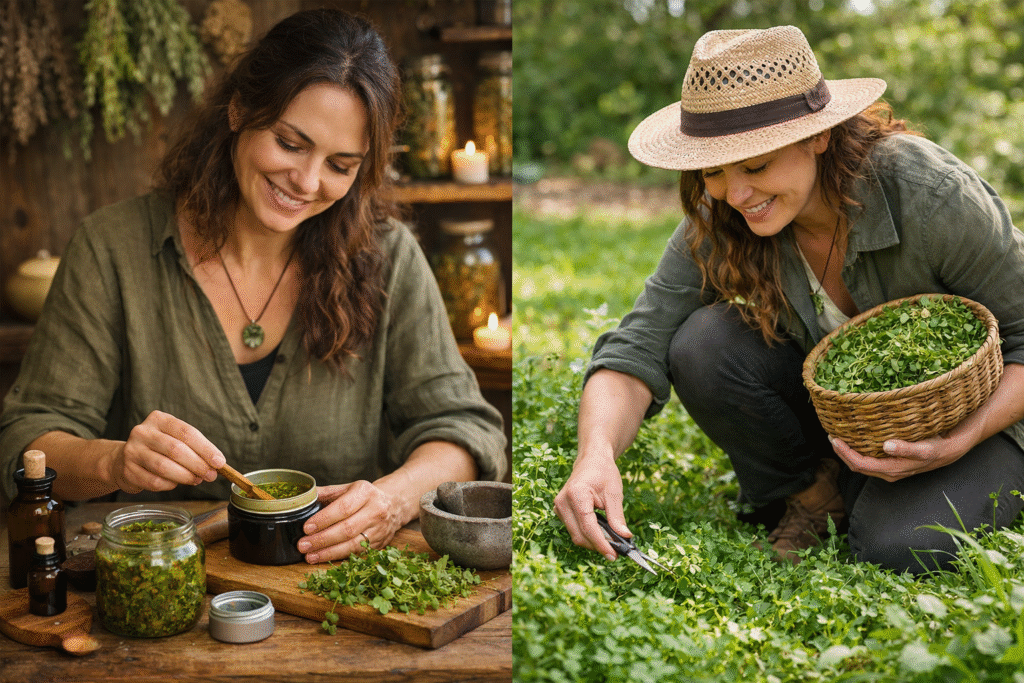
Image by Kathy McCabe & OpenAI
Every spring, just as the soil begins to soften here in Pennsylvania, chickweed (Stellaria media) quietly appears—lush, bright green, and often overlooked.
It spreads low across the ground, weaving itself through garden beds, along pathways, and even into our lawns. Most people see a weed. Herbalists see one of the most soothing and generous plants of the season.
If you’ve ever felt inflamed, overheated, or just “off” after winter, chickweed is exactly the kind of ally your body may be craving.
Identification: Getting to Know Chickweed
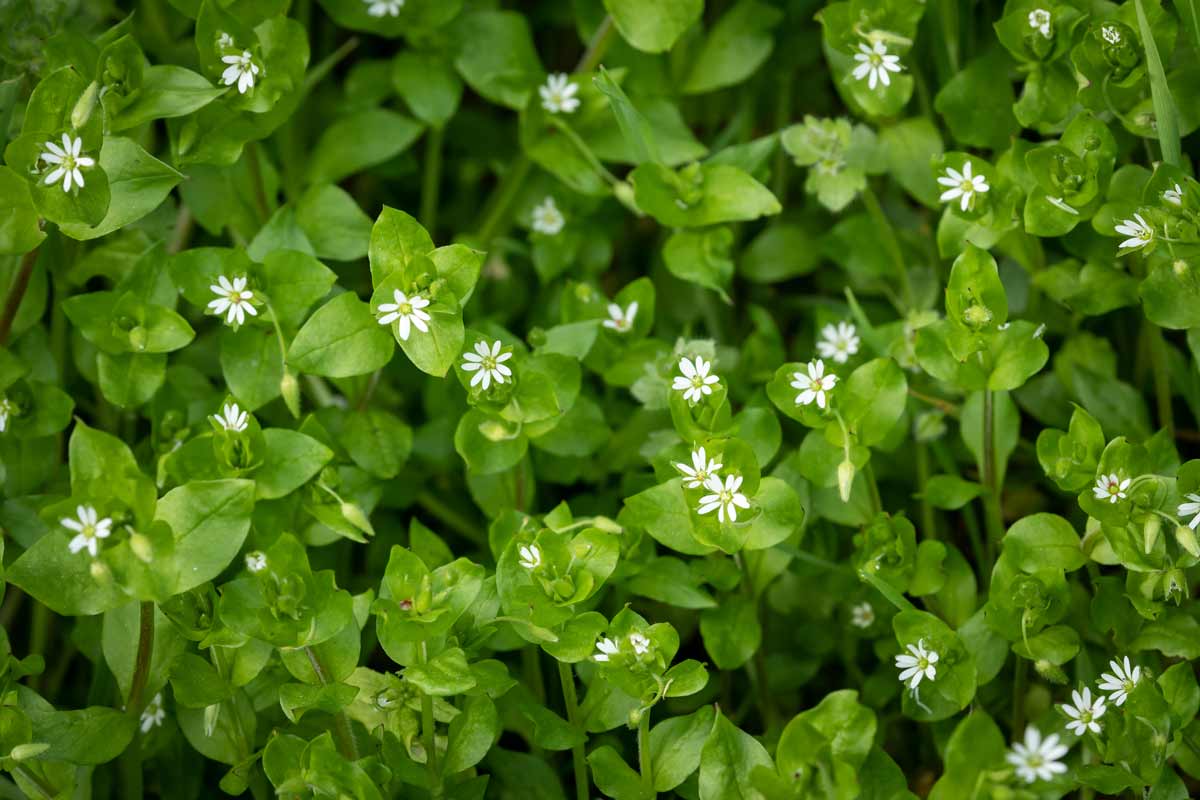
Chickweed is gentle in both nature and appearance, but there are a few key features to help you confidently identify it:
- Tiny white flowers with deeply notched petals (they look like 10, but are actually 5)
- Small, oval, bright green leaves
- A delicate, sprawling growth habit
- The signature trait: a single line of fine hairs running along the stem
This last detail is one of the most reliable ways to distinguish chickweed from lookalikes.
Energetics & Herbal Actions
From an energetic perspective, chickweed is:
- Cooling
- Moistening
- Slightly nutritive
These qualities make it especially helpful for modern constitutions that tend toward heat, dryness, and irritation.
Primary herbal actions include:
- Anti-inflammatory
- Demulcent (mild tissue soothing)
- Vulnerary (supports skin healing)
- Lymphatic support
- Gentle alterative
This is not a forceful herb—it works slowly, steadily, and in harmony with the body.
Why Chickweed Matters (Especially Now)
In my practice and personal use, chickweed is one of those herbs I reach for when things feel:
- Inflamed
- Congested
- Irritated
- Stagnant
It’s particularly helpful for individuals with sensitive systems, where stronger herbs may aggravate rather than support.
Think of chickweed as a cooling whisper rather than a loud intervention.
Skin Support: Chickweed’s Most Famous Role
Chickweed has a long-standing reputation as a skin-soothing herb, especially where heat and irritation are present.
It may be used for:
- Eczema
- Rashes
- Minor wounds
- Bug bites
- Dry, itchy skin
A traditional preparation involves infusing the fresh herb into oil (after slight wilting), then turning it into a salve. The result is deeply soothing and gentle enough for regular use.
Lymphatic & Internal Support
Chickweed also offers subtle but meaningful support for the lymphatic system.
Rather than aggressively stimulating movement, it works gently to:
- Encourage fluid balance
- Ease mild lymphatic congestion
- Support overall detoxification pathways
This makes it especially appropriate for individuals who feel “stuck” but cannot tolerate strong detox herbs.
Digestive Support for Sensitive Systems
Chickweed’s cooling and moistening qualities extend to the digestive system as well.
It may help:
- Soothe mild irritation
- Reduce that “hot” or inflamed digestive feeling
- Provide gentle support without overstimulation
It pairs beautifully with:
- Marshmallow (Althaea officinalis)
- Plantain (Plantago major)
- Chamomile (Matricaria chamomilla)
For those navigating reflux, sensitivity, or general digestive fragility, chickweed can be a welcome addition.
️ Chickweed as Food: Everyday Herbalism
One of the most beautiful aspects of chickweed is that it is not just medicine—it is food.
Its flavor is mild, slightly sweet, and very approachable.
Ways to enjoy chickweed:
- Tossed fresh into salads
- Blended into pesto
- Added to smoothies
- Lightly wilted like spinach
Because chickweed is so delicate, it is best used fresh whenever possible.
Preparations
Chickweed can be prepared in a variety of ways depending on your needs:
- Fresh herb tincture (1:2 or 1:3)
- Infused oil (fresh, lightly wilted herb)
- Salve
- Vinegar infusion (for minerals and daily use)
- Fresh juice
Drying is possible, but much of chickweed’s vitality is lost in the process.
⚠️ Contraindications & Considerations
Chickweed is considered a very safe herb, though a few considerations apply:
- Large amounts may cause mild digestive upset
- Best used with care in individuals with very cold or damp constitutions
- Rare allergic reactions may occur
There are no well-documented drug interactions, though it is always wise to monitor when combining herbs with medications, particularly those affecting fluid balance.
Harvesting Chickweed in the Mid-Atlantic
For those of us in Pennsylvania and the Mid-Atlantic region, chickweed begins appearing in early spring and often thrives through late spring.
- Prefers moist, nutrient-rich soil
- Grows well in partial shade
- Most tender before flowering, though still usable afterward
If you step outside right now, there’s a good chance it’s already growing nearby.
Simple Chickweed Infusion (Gentle & Cooling)
Spring Cooling Tea Blend:
- 2 parts chickweed
- 1 part marshmallow leaf
- 1 part chamomile
Steep in warm (not boiling) water for 10–15 minutes.
This blend is especially supportive for:
- Digestive irritation
- Mild inflammation
- Sensitive systems needing gentle care
References
- Hoffmann, D. (2003). Medical Herbalism: The Science and Practice of Herbal Medicine. Healing Arts Press.
- Tilgner, S. (2009). Herbal Medicine From the Heart of the Earth. Wise Acres Press.
- Wood, M. (2008). The Earthwise Herbal, Volume I. North Atlantic Books.
- Chevallier, A. (2016). Encyclopedia of Herbal Medicine. DK Publishing.
- Gladstar, R. (2012). Herbal Recipes for Vibrant Health. Storey Publishing.

Kathy is an herbalist/naturopathy practitioner who is constantly researching to expand her knowledge. She came to herbalism after her migraine medicine was suddenly removed from the market and she had to find something new. After discovering the magic of herbs she’s never looked back. She is accredited by the International Practitioners of Holistic Medicine (IPHM) View her courses of study.