
The Itchy Side of Nature: Respecting the Plants That Protect Themselves
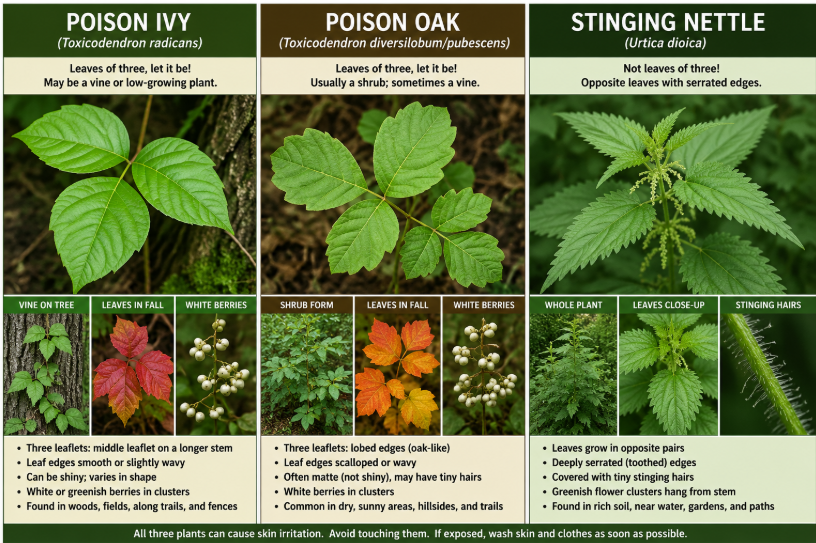
Images created by Herbal Journal & OpenAI
Nature doesn’t create “good” plants and “bad” plants—it creates plants that have adapted to survive.
Some attract pollinators with colorful flowers. Others produce fragrant oils to discourage insects. Some protect themselves with thorns, while others rely on chemical compounds or tiny stinging hairs to persuade curious animals—including us—to keep their distance.
Whether you’re hiking a woodland trail, tending the garden, photographing wildflowers, or simply exploring your own backyard, you’ve likely encountered one of nature’s best-known defenders: poison ivy, poison oak, poison sumac, or stinging nettle.
Although these plants can cause itching, burning, and painful skin irritation, they aren’t trying to harm us. Their defenses evolved long before humans walked the landscape. Our discomfort is simply an unintended consequence of brushing against a plant that has developed remarkably effective ways to protect itself.
As herbalists, gardeners, photographers, and nature enthusiasts, our goal isn’t to fear these plants—it is to understand them, recognize them, and respect the important roles they play in healthy ecosystems. So far, in my forays into nature as a child and as an adult, I’ve been very lucky to not have had reactions to these plants – even after exposure. But this isn’t true for everyone, and it can change at any time.
While poison ivy, poison oak, and poison sumac are best admired from a respectful distance, stinging nettle reminds us that a plant capable of causing temporary discomfort can also become one of nature’s most nourishing herbal allies once properly prepared.
Let’s take a closer look at these remarkable plants—and what they can teach us.
Poison Ivy (Toxicodendron radicans)
Perhaps the best-known itchy plant in North America, poison ivy has earned its famous saying:
Leaves of three, let it be.
It grows as both a ground cover and a climbing vine, often wrapping around trees, fence posts, and stone walls. Throughout the seasons, its appearance changes dramatically—from bright green spring leaves to lush summer foliage and brilliant reds and oranges in autumn.
Why Does It Cause a Rash?
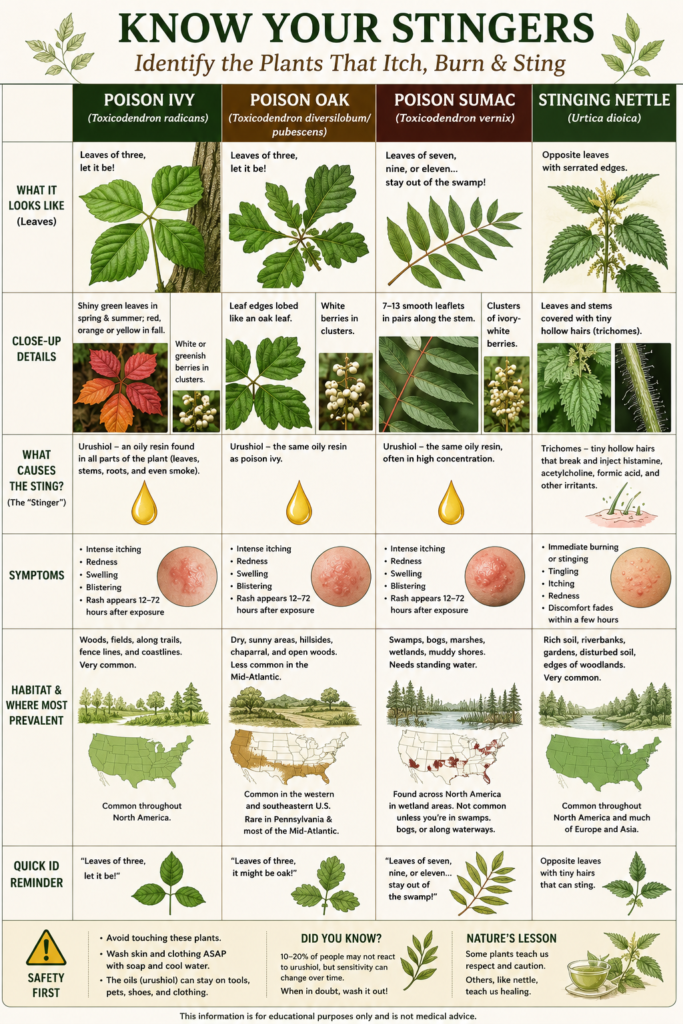
Poison ivy contains an oily resin called urushiol, found in nearly every part of the plant, including the leaves, stems, roots, and even the smoke produced if the plant is burned.
When urushiol contacts the skin, about 80–90% of people develop an allergic reaction. Interestingly, approximately 10–20% of people show little or no reaction, although sensitivity can develop later in life after repeated exposure.
Symptoms may include:
- Intense itching
- Redness
- Swelling
- Blistering
- Rash appearing 12–72 hours after exposure
Contrary to popular belief, the blisters themselves are not contagious. Once the urushiol oil has been washed away, the rash cannot spread to another person.
Does Poison Ivy Have Medicinal Uses?
Historically, poison ivy appeared in a handful of highly diluted homeopathic preparations and was occasionally discussed in nineteenth-century medical literature for rheumatic pain and certain skin conditions.
Modern herbal medicine, however, does not recommend using poison ivy internally or externally. The risks far outweigh any potential benefit.
Sometimes the best herbal lesson is simply learning to identify a plant and leave it undisturbed.
Poison Oak (Toxicodendron diversilobum & Toxicodendron pubescens)
Poison oak is closely related to poison ivy and contains the same irritating oil—urushiol.
Its leaves resemble those of an oak tree, although the plant may grow as either a shrub or a climbing vine depending on the region.
Symptoms are nearly identical to poison ivy:
- Severe itching
- Redness
- Swelling
- Blistering
Some people experience even stronger reactions to poison oak than to poison ivy.
While poison oak is common in parts of the western and southeastern United States, it is relatively uncommon throughout much of the Mid-Atlantic. Many plants mistaken for poison oak are actually poison ivy with more deeply lobed leaves.
Like poison ivy, poison oak has very little place in modern herbal medicine beyond historical homeopathic preparations.
A Quick Note About Poison Sumac
You may notice that poison sumac (Toxicodendron vernix) isn’t featured as prominently in this article or the accompanying graphics. That decision was intentional.
Although poison sumac contains the same irritating oil—urushiol—and can produce an equally severe, or sometimes even more intense, allergic reaction, it is encountered far less often by most readers in the Mid-Atlantic.
Unlike poison ivy, which thrives along woodland edges, trails, fence rows, and even suburban backyards, poison sumac prefers wet, acidic habitats such as swamps, bogs, marshes, and poorly drained wetlands.
It is also fairly easy to recognize once you know what to look for. Instead of the familiar “leaves of three,” poison sumac typically has 7–13 smooth-edged leaflets arranged in pairs along a central stem, along with clusters of pale ivory or greenish-white berries.
If you enjoy photographing wetlands, birding, or exploring marshes, poison sumac is certainly worth learning to identify. For the average gardener or woodland hiker, however, poison ivy remains the species you’re most likely to encounter.
Knowing the plants that grow in your local environment is one of the best ways to stay safe while enjoying nature.
Stinging Nettle (Urtica dioica)
Unlike the poison plants, stinging nettle doesn’t rely on an oily resin.
Instead, its leaves and stems are covered with thousands of tiny hollow hairs called trichomes. These microscopic hairs break when touched, injecting compounds including histamine, acetylcholine, serotonin, formic acid, and other natural irritants into the skin.
The result is immediate:
- Burning
- Tingling
- Itching
- Redness
Fortunately, the discomfort usually fades within a few hours.
When it’s not defending itself, stinging nettle is a super herb!
One of Nature’s Most Nourishing Herbs
Once dried or cooked, the stinging hairs become inactive, revealing one of the most nutrient-dense herbs in the herbal apothecary.
Nettle is naturally rich in:
- Iron
- Calcium
- Magnesium
- Potassium
- Silica
- Vitamins A, C, and K
- Chlorophyll
Traditional herbalists have long valued nettle to support:
- Seasonal allergies
- Healthy inflammatory response
- Joint comfort
- Urinary tract health
- Prostate health
- Mineral replenishment
- Postpartum nutrition
- Hair and scalp care
Many herbalists also enjoy nettle as a nourishing tea, appreciating its gentle support for overall wellness and its impressive mineral content.
An Interesting Piece of Herbal History: Centuries ago, some practitioners intentionally brushed sore joints with fresh nettles in a therapy known as urtication. The temporary sting was believed to increase circulation and ease arthritic discomfort.
Although historically fascinating, this practice has limited modern evidence and is generally not recommended today.
First Aid
Poison Ivy, Poison Oak & Poison Sumac
If exposure is suspected:
- Wash skin immediately with cool water and soap.
- Remove contaminated clothing.
- Wash shoes, gloves, tools, and pet fur if they may have brushed against the plant.
- Apply cool compresses.
- Colloidal oatmeal baths may soothe itching.
- Seek medical attention if the rash involves the eyes, face, mouth, or causes difficulty breathing.
Stinging Nettle
If you’ve brushed against fresh nettles:
- Avoid rubbing the area.
- Rinse gently with cool water.
- Lift remaining hairs with adhesive tape if needed.
- Apply a cool compress.
- Fresh plantain, chickweed, or aloe vera may provide soothing relief.
Nature’s Defenders at a Glance
Every plant discussed in this article developed its defenses for survival—not to harm people.
- Poison Ivy: Chemical defense (urushiol oil)
- Poison Oak: Chemical defense (urushiol oil)
- Poison Sumac: Chemical defense (urushiol oil)
- Stinging Nettle: Physical and chemical defense (microscopic stinging hairs called trichomes)
Understanding these defenses helps us appreciate the remarkable ways plants have adapted to thrive while reminding us that observation is often the best interaction.
Walking Away a Little Wiser
Every walk in the woods offers an opportunity to learn.
The plants we’ve explored here aren’t trying to make our lives miserable—they’re simply using the remarkable defenses nature gave them. By learning to recognize poison ivy, poison oak, poison sumac, and stinging nettle, we become more confident outdoors and more appreciative of the incredible adaptations that help these species thrive.
Sometimes the greatest lesson a plant can teach us isn’t how to harvest it or use it in the apothecary. Sometimes it’s simply learning to admire it, respect it, and leave it exactly where it belongs.
The next time you spot one of these plants along a trail, perhaps you’ll see it a little differently—not as an enemy, but as another fascinating member of nature’s diverse community.
Safety Note
This article is intended for educational purposes only and should not be considered medical advice. Never ingest or apply poison ivy, poison oak, or poison sumac as herbal remedies. If you experience a severe allergic reaction, widespread blistering, swelling of the face or throat, or difficulty breathing after exposure, seek immediate medical attention.
Thanks for reading! Download the Know Your Stingers Infographic
Kathy McCabe, Hilltop Herb Woman

Kathy is an herbalist/naturopathy practitioner who is constantly researching to expand her knowledge. She came to herbalism after her migraine medicine was suddenly removed from the market and she had to find something new. After discovering the magic of herbs she’s never looked back. She is accredited by the International Practitioners of Holistic Medicine (IPHM) View her courses of study.
[…] immediate steps, soothing options and signs that medical care may be needed, visit our complete Itchy Plants: Poison Ivy, Poison Oak, Poison Sumac and Stinging Nettles […]