
Three Tincture Methods: Choosing the Right Method
Choosing the Right Method for Your Herb and Your Goals
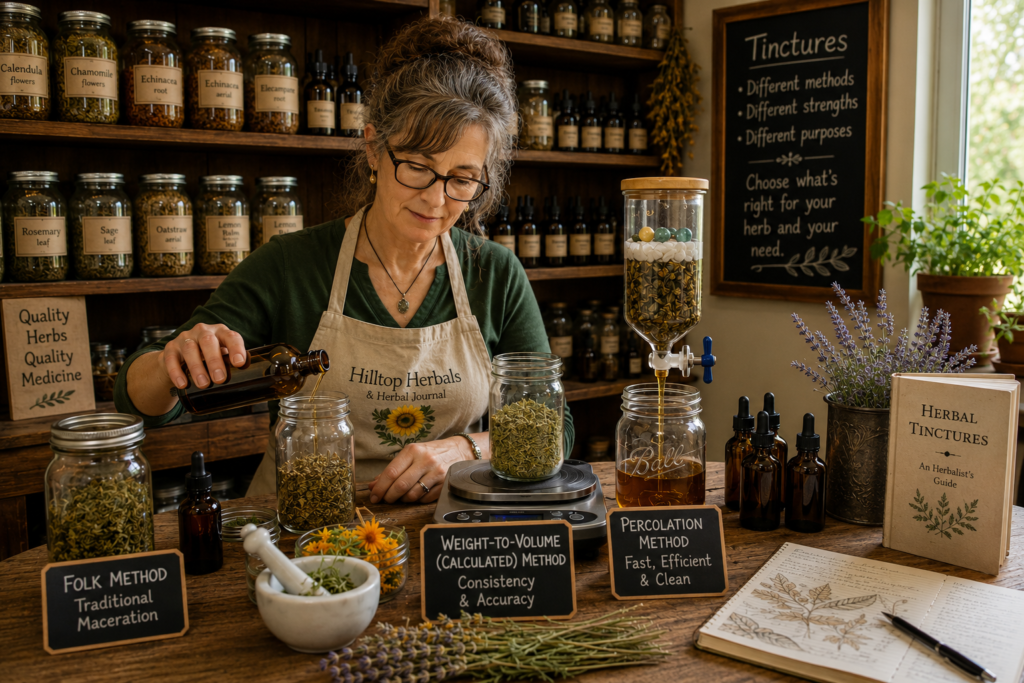
Images by Herbal Journal & OpenAI
One of the questions I hear most often is:
“What is the best way to make a tincture?”
The answer is… it depends.
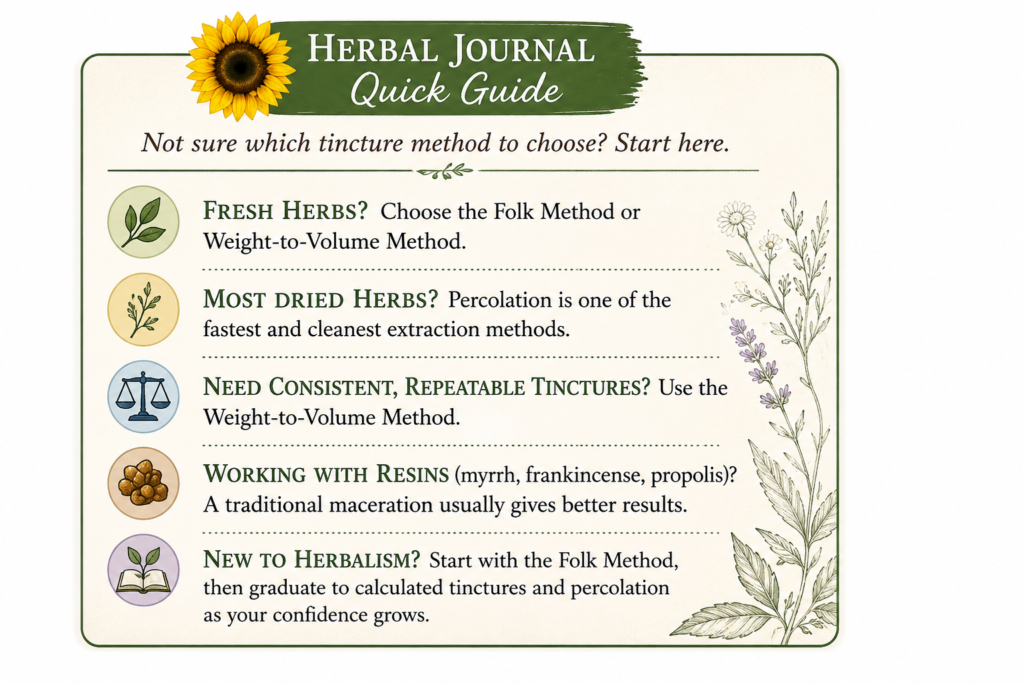
Herbalists have developed several methods for preparing tinctures, each with its own strengths, limitations, and ideal uses. While the finished bottle may look similar, the way the tincture was prepared can affect consistency, speed, ease of preparation, and even the amount of sediment that ends up in the finished medicine.
The three methods most home herbalists encounter are:
- Folk Method (Traditional Maceration)
- Weight-to-Volume (Calculated) Method
- Percolation Method
Rather than competing with one another, I think of these as different tools in the herbalist’s toolbox.
 The Folk Method
The folk method is the oldest and perhaps the most approachable technique. Herbs are placed into a jar, covered completely with alcohol, and allowed to macerate for four to six weeks before straining.
Because the herb is measured by sight rather than by weight, every batch is slightly different. For many home herbalists, that’s perfectly acceptable.
Advantages
- Extremely beginner-friendly
- Minimal equipment required
- Excellent for fresh herbs
- Traditional and intuitive
- Easy to prepare in small batches
Limitations
- Difficult to duplicate exactly
- Potency varies from batch to batch
- Less precise for formulation work
If you’re just beginning your herbal journey, the folk method is an excellent place to start.
The Weight-to-Volume (Calculated) Method
The calculated method brings precision to tincture making. Instead of estimating the amount of herb, the plant material is weighed and matched to a specific volume of menstruum.
Common examples include:
- Fresh herbs: 1:2
- Dried herbs: 1:5
This allows every batch to be reproduced with remarkable consistency.
Many clinical herbalists prefer this approach because they know exactly how much herb is represented in every milliliter of finished tincture.
Advantages
- Highly repeatable
- Consistent potency
- Excellent for documenting recipes
- Ideal for formulation work
Limitations
- Requires a scale
- Requires calculations
- Still requires a four- to six-week maceration period
The Percolation Method
Percolation is entirely different from traditional maceration.
Instead of soaking herbs for weeks, the menstruum slowly passes through a tightly packed column of pre-moistened dried herb. Gravity continuously pulls fresh solvent through the herb column, creating an efficient extraction.
Although setup requires more care, the finished tincture can often be completed in about 24 hours after the digestion period.
I particularly enjoy using percolation for dried herbs because it produces beautiful, clean tinctures with very little sediment.
Advantages
- Very fast
- Excellent consistency
- Cleaner finished tinctures
- Ideal for most dried herbs
- Great for roots, bark, leaves, flowers, and seeds
Limitations
- Requires more equipment
- Requires careful calculations
- Not ideal for highly resinous herbs
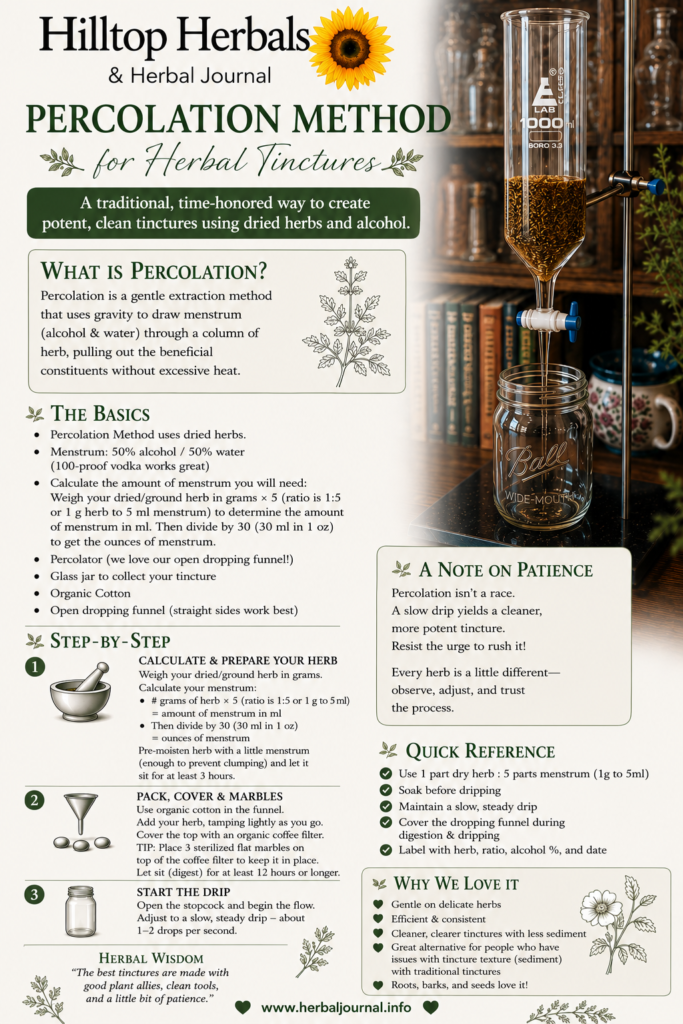
Download this Infographic
My Percolation Method
As with many herbal techniques, every herbalist develops their own workflow over time.
My own percolation method uses:
- An open dropping funnel
- Organic cotton beneath the herb in the column
- An organic coffee filter over the packed herbs
- Three sterilized flat marbles to keep the filter in place when pouring menstruum
- A covered funnel during both digestion and dripping
- A calculated 1:5 ratio for dried herbs
- A digestion period of at least 12 hours (I usually allow 18–20 hours)
These small adjustments have consistently produced clean, reliable tinctures while making the process easier to manage.
Which Herbs Work Best?
Every herb is unique.
Most dried roots, bark, leaves, flowers, and seeds perform exceptionally well with percolation.
Highly resinous botanicals—including myrrh, frankincense, propolis, pine pitch, and other sticky resins—generally respond better to a traditional maceration because they can slow or even clog a percolation setup.
Likewise, many fresh herbs are ideally suited to either the folk or weight-to-volume methods because their natural moisture content becomes part of the extraction.
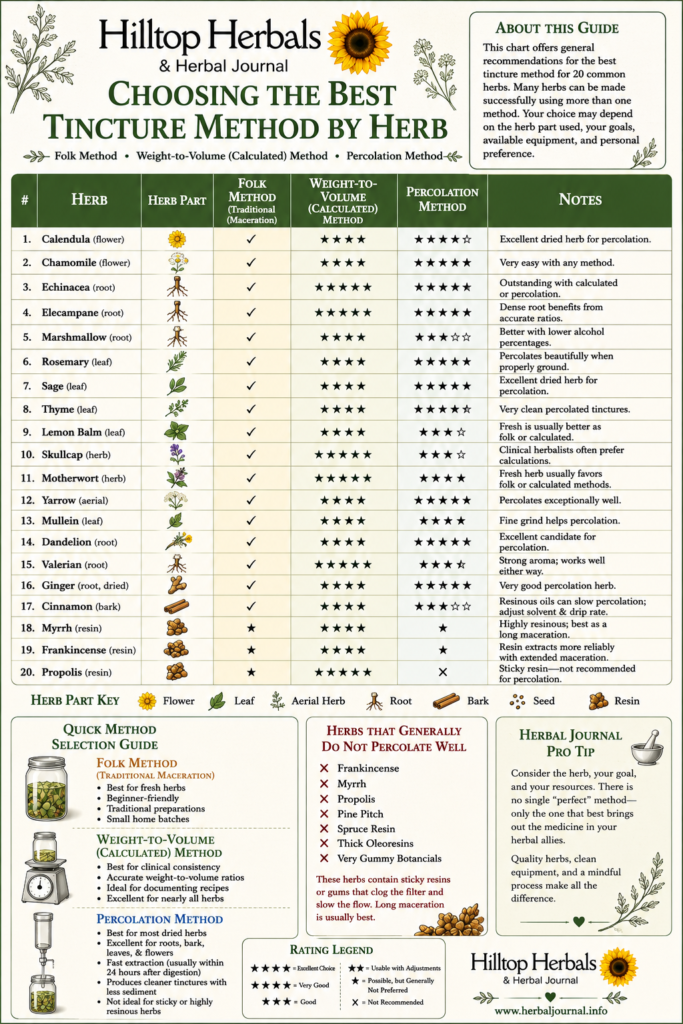
Download this infographic
Which Method Do I Recommend?
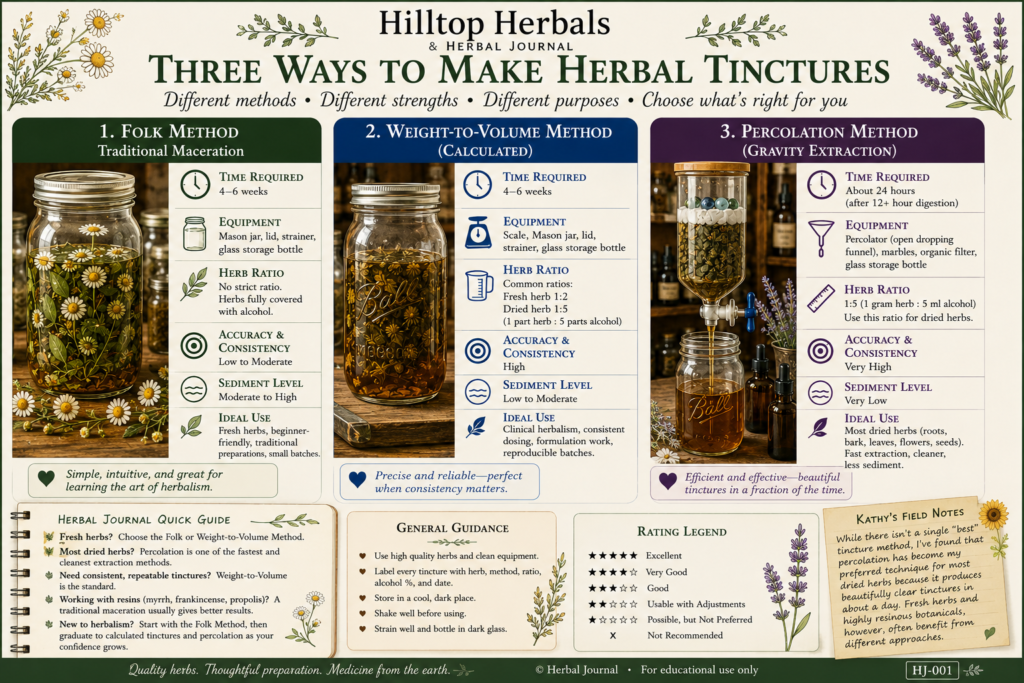
For someone making their very first tincture, I usually recommend the folk method. It teaches patience, observation, and familiarity with the plants.
If consistency is your priority, the weight-to-volume method is difficult to beat.
If you primarily work with dried herbs and enjoy a little herbal engineering, percolation has become my favorite. Once you become comfortable with the technique, you’ll likely appreciate the speed, the clarity of the finished tincture, and the reduced sediment.
Herbal Journal Note
While I enjoy traditional tincture-making methods, I also use modern equipment when it makes sense. One of my favorite tools is the ONGROK Botanical Infuser. I find it especially useful for very sticky formulas and resin-rich blends, such as my Eye Health Blend, where prolonged mixing and controlled heat help produce a beautifully incorporated extract. Like any tool, it doesn’t replace understanding herbal preparations—it simply offers another option when it’s the right fit.
Final Thoughts
One of the things I love most about herbalism is that there is rarely only one “right” answer.
Each tincture method has earned its place through generations of practice.
Whether you choose the simplicity of the folk method, the precision of weight-to-volume calculations, or the efficiency of percolation, quality herbs, careful preparation, and thoughtful observation remain the most important ingredients.
The best tincture isn’t determined solely by the method—it’s determined by the care that goes into making it.
Thanks for reading! Kathy “Hilltop Herb Woman”
Be sure to download these infographics: Percolation Method Tincture by Herb
References
- James Green. The Herbal Medicine-Maker’s Handbook. Crossing Press.
- Richo Cech. Making Plant Medicine. Horizon Herbs.
- Michael Moore. Forms, Worksheets, and Percolation Worksheets, Southwest School of Botanical Medicine.
- Maria Noël Groves. How to Make Herbal Tinctures and Percolation: A Quick Guide to Dry Herb Tinctures. Wintergreen Botanicals.
- Mountain Rose Herbs. How to Make Herbal Tinctures (Guide to Tinctures & Extracts).

Kathy is an herbalist/naturopathy practitioner who is constantly researching to expand her knowledge. She came to herbalism after her migraine medicine was suddenly removed from the market and she had to find something new. After discovering the magic of herbs she’s never looked back. She is accredited by the International Practitioners of Holistic Medicine (IPHM) View her courses of study.