
Kratom Deserves a More Careful Conversation
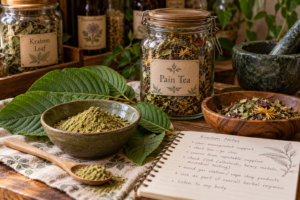
Image by Herbal Journal and OpenAI
Kratom is in the news again following the tragic deaths of two students at the University of Mississippi. Packaged kratom was reportedly found during both investigations.
But there is something important to say before going any further: authorities have not determined that kratom caused either death. Toxicology results are still pending.
That distinction matters.
Kratom (Mitragyna speciosa) is a Southeast Asian tree with a long history of traditional use. Its leaves have been used for fatigue and physical endurance and traditionally for discomfort and pain. Today, some people also report using kratom to manage chronic pain or symptoms associated with opioid withdrawal.
Research into those uses is still developing. Kratom has not been approved by the FDA to treat pain or any other medical condition, and it is not without risk. Regular use can produce dependence and withdrawal, and adverse effects including nausea, constipation, dizziness and, more rarely, serious effects have been reported.
But there is another side to this conversation that is deeply personal to me.
There was a period when I was living with significant pain and was medically abandoned by the pain clinic and doctors. I vividly remember sitting in an examination room, obviously hurting, while a physician told me I didn’t need to be taking “that sh*t,” referring to opioid pain medication.
Taking away pain medication didn’t take away my pain.
During that period, kratom, and my own herbal blends, became important parts of how I managed it.
That experience doesn’t make kratom harmless, and I would never suggest that it is appropriate for everyone. But it does make me reluctant to watch a complicated medicinal plant reduced to a frightening headline.
What concerns me most is the marketplace
The kratom sold today isn’t necessarily one uniform product.
Plain kratom leaf is very different from highly concentrated extracts and products containing enhanced levels of 7-hydroxymitragynine, commonly called 7-OH. The FDA has specifically raised serious concerns about concentrated 7-OH products, some of which are sold as shots, gummies and tablets in gas stations, smoke shops and similar retailers.
Product quality matters, too. Kratom products have previously been found contaminated with bacteria and heavy metals.
If someone chooses to use kratom, source matters enormously.
I would avoid impulse-purchase kratom from gas stations, convenience stores and vape or smoke shops. Look instead for an established supplier that provides clear labeling and independent laboratory testing for identity, alkaloid content, microbial contamination and heavy metals. A certificate of analysis should be available.
The American Kratom Association also maintains a Good Manufacturing Practices program in which participating manufacturers undergo independent third-party audits. That isn’t a guarantee that kratom is safe or appropriate for a particular person, but manufacturing standards and testing provide considerably more information than an anonymous packet sitting beside the register at a gas station.
And I would be particularly cautious about products marketed as “extra strength,” highly concentrated, enhanced with 7-OH, or designed primarily to produce an intense effect. Those are not the traditional botanical preparations on which kratom’s long history of use was built.
Responsible herbalism includes uncomfortable conversations
Responsible herbalism doesn’t mean declaring every plant safe because it is natural.
It means respecting potency, recognizing contraindications and interactions, understanding the possibility of dependence, knowing your source, paying attention to preparation and product quality, and being willing to acknowledge when the evidence is incomplete.
It also means recognizing that people’s experiences matter.
For some people—including me—kratom has occupied a very different place than the one portrayed in frightening headlines. At one of the most difficult points in my experience with chronic pain, it mattered. But I did a massive amount of research, and asked many questions before I added kratom to my herbal regimen.
That doesn’t erase its risks.
And its risks don’t erase that experience.
As we learn what happened to these two young men, their families deserve compassion and investigators deserve the opportunity to establish the facts without speculation.
Kratom deserves something similar: careful research, responsible sourcing, sensible regulation and an honest conversation that is capable of holding both benefit and risk at the same time.
Kathy is an herbalist/naturopathy practitioner who is constantly researching to expand her knowledge. She came to herbalism after her migraine medicine was suddenly removed from the market and she had to find something new. After discovering the magic of herbs she’s never looked back. She is accredited by the International Practitioners of Holistic Medicine (IPHM) View her courses of study.