
My Apothecary – Sacred Space
My Apothecary: My Space, My Practice, My Center
I know… I talk about my apothecary a lot. But there’s a reason for that. This space—it’s mine.
It’s where I get to play a little bit like a mad scientist, blending, testing, experimenting, and sometimes making a complete mess in the process. It’s where I learn, where I make mistakes, where I discover what works (and what definitely doesn’t). And it’s where I share my passion for herbs in the most hands-on, real way possible.
More than anything… It’s where I feel centered.
When life gets busy, when everything feels a little too loud or scattered, this is the place I come back to. There’s something about the quiet rhythm of working with plants—measuring, mixing, labeling, observing—that brings everything back into focus.
And while it may look like shelves and jars to someone else… to me, it’s so much more.
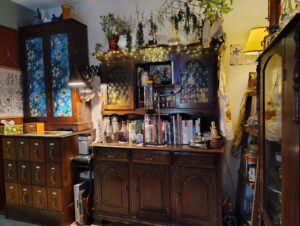
Kathy’s Apothecary
A Living, Breathing Apothecary
My apothecary isn’t perfectly styled or staged.
It’s alive.
You’ll find herbs hanging overhead, slowly drying—some from my yard here in South Central Pennsylvania, others carefully sourced. There are jars filled with roots and leaves, powders and petals, each one representing a season, a harvest, or a moment of curiosity.
There are tinctures quietly steeping, books within reach, and tools that have become extensions of my hands over time.
And yes… sometimes there are open doors, half-finished projects, and a few “what was I doing here?” moments.
That’s part of it, too.
The Practical Side of a Creative Space
As much as this space is about intuition and creativity, it also needs to function.
Because when you’re working with dozens (or hundreds) of herbs, things can quickly go from “charming chaos” to actual chaos.
That’s where systems come in.
To help keep track of everything, I use a free inventory system called Stockpile.
It helps me:
- Keep track of what I have on hand
- Monitor quantities and storage
- Avoid overbuying duplicates
- Stay aware of what needs to be used up
It’s not fancy—but it works. And sometimes, that’s exactly what you need.
Because the more organized the background is, the more freedom I have to play in the foreground.
When “Good Enough” Isn’t Enough
Using an inventory system has been incredibly helpful—but like many herbalists, I started thinking… What would this look like if it was designed specifically for how we work? Because our needs aren’t just about inventory.
We’re tracking:
- Energetics
- Formulations
- Observations
- Research and ongoing learning
So, naturally… I started designing my own app. This project is still evolving, but at its heart, it’s about creating something that supports the way herbalists actually think and work.
Not just lists—but relationships. Not just storage—but understanding.
What I’m Building Toward:
- 🌿 Inventory with customizable tags and filters
- 📅 Freshness and expiration reminders
- 🧪 Formula tracking with notes and adjustments
- 📝 A dedicated research and learning space
- 🔍 Search by action, use, or intuition (not just name)
The goal isn’t to replace the apothecary. It’s to support it. To create a bridge between the physical and the digital, so the practice flows more smoothly.
Keeping the Space Functional (Without Losing the Magic)
Even with digital tools, how the space is set up matters.
I Organize by Use
Digestive herbs together. Nervines together. Skin support together. It makes formulation intuitive.
I Keep My Favorites Close
The herbs I reach for daily are always within arm’s reach.
I Separate Bulk from Working Supply
Bulk storage stays protected. Smaller jars are what I interact with daily.
When Space Is Limited…
Let’s be honest—not all of us have endless room for shelves and jars.
When I’m working with larger quantities but don’t have the space to store everything in glass, I’ll use BPA-free vacuum sealing bags for bulk storage.
This has been a game-changer.
- It reduces exposure to air (which helps preserve potency)
- Keeps moisture out
- Takes up significantly less space
- Allows me to store herbs long-term and transfer smaller amounts into working jars as needed
If you go this route, I still recommend:
- Labeling clearly (herb name, date, source)
- Storing the sealed bags in a cool, dark place
- Checking periodically for any moisture issues
It’s not as pretty as rows of jars—but it’s incredibly practical.
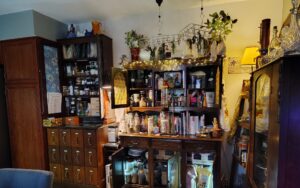
The ‘magic’ within
Drying, Storing, and Respecting the Plants
That drying rack above my apothecary? It’s not just decoration—it’s part of the rhythm.
Drying Basics
- Good airflow
- No direct sunlight
- Loose bundles
Storage
- Glass jars, when possible
- Cool, dark, dry environment
- Clear labeling (name, date, source)
I highly recommend getting a cheap thermal printer, and printing detailed labels – and placing them on your glass jars over a large disolvable (canning type) label. You’ll thank me later when it comes time to remove the label!
Because how we store herbs directly impacts how well they work.
Why I Keep Coming Back Here
At the end of the day, this space isn’t about being perfect.
It’s about being present.
It’s where I learn. Where I experiment. Where I reconnect. Where I get to follow curiosity without needing everything to be figured out ahead of time. And yes… it’s where I play mad scientist.
But it’s also where I come back to myself.
And that’s why I’ll probably keep talking about it.
Download Herbal Journal’s Apothecary Setup Guide
References & Further Reading
- American Herbalists Guild. (n.d.). Herbal Safety & Practice Guidelines
- Gladstar, R. (2012). Herbal Recipes for Vibrant Health
- Hoffmann, D. (2003). Medical Herbalism
- Tilgner, S. (2009). Herbal Medicine From the Heart of the Earth

Kathy is an herbalist/naturopathy practitioner who is constantly researching to expand her knowledge. She came to herbalism after her migraine medicine was suddenly removed from the market and she had to find something new. After discovering the magic of herbs she’s never looked back. She is accredited by the International Practitioners of Holistic Medicine (IPHM) View her courses of study.