
The Real Science of Weight Loss
The Real Science of Weight Loss (and Where Herbs Actually Fit In)

Image by Kathy McCabe & OpenAI
I’m going to say this right up front:
There is no herb, tea, powder, or “fat-burning” formula that overrides basic human physiology.
And honestly? That’s good news.
Because it means we can step away from gimmicks, stop chasing the next miracle solution, and come back to something much more grounded — and much more sustainable.
Let’s talk about what actually drives weight loss… and where herbs like chickweed and purslane quietly (but meaningfully) support the process.
What Science Really Says About Weight Loss
At its most basic level, weight loss happens when the body uses more energy than it takes in.
But that simple idea sits on top of a much more complex system that includes:
- Hormones (especially insulin and cortisol)
- Muscle mass
- Sleep quality
- Stress levels
- Nutrient status
- Blood sugar stability
So yes — calories matter. But they’re not the whole story.
The sustainable approach (not the trendy one)
Research consistently supports a few key things:
- A modest calorie deficit works better than extreme restriction
- Protein intake helps preserve muscle during weight loss
- Fiber supports fullness and digestion
- Strength training helps maintain metabolic health
- Sleep plays a major role in hunger and weight regulation
Not flashy. Not exciting. But incredibly effective.
“We’re not saying that weight loss medications shouldn’t be used for those who need them. We’re only providing other information.
Where Herbs Fit In (Honestly)
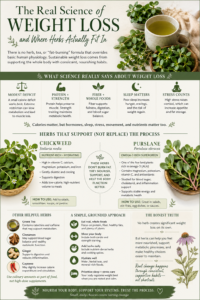
Image by Kathy McCabe & OpenAI Download this information sheet
Here’s where I like to gently shift the conversation. Herbs are not “fat burners.” They don’t override metabolism or melt weight away.
What they can do is support the systems that influence weight:
- Blood sugar balance
- Digestion
- Inflammation
- Stress response
- Nutrient density
And that last one — nutrient density — is where some of my favorite wild herbs really shine.
Chickweed (Stellaria media)
If you’ve followed me for any length of time, you already know I love chickweed.
It’s one of those humble, abundant plants that doesn’t look like much — but nutritionally, it quietly delivers.
What chickweed offers
Chickweed is rich in:
- Vitamin C
- Calcium
- Magnesium
- Potassium
- Iron
It’s also:
- Gently cooling and hydrating
- Mildly diuretic
- Supportive to digestion and elimination
How this supports weight regulation
Not by “burning fat,” but by:
- Supporting fluid balance (helpful for bloating)
- Providing low-calorie, high-nutrient volume
- Helping you feel nourished with real food
Sometimes the simplest shift — adding fresh, mineral-rich plants — changes how the body signals hunger and satisfaction.
Easy ways to use chickweed
- Toss into salads (mild and slightly sweet)
- Blend into smoothies
- Stir into soups at the end of cooking
Purslane (Portulaca oleracea)
Purslane is one of the most underrated plants out there — and one of the most nutritionally impressive.
What makes purslane special
Purslane contains:
- Omega-3 fatty acids (ALA), which is rare in leafy plants
- Magnesium and potassium
- Vitamin C
- Antioxidants
It has also been studied for:
- Blood sugar regulation
- Cholesterol balance
- Inflammation
How this supports weight regulation
Again, not directly — but meaningfully:
- Supports more stable blood sugar, which may reduce cravings
- Provides nutrient density, which can reduce the drive to overeat
- Supports overall metabolic health over time
Easy ways to use purslane
- Add to salads (slightly lemony and crisp)
- Toss into eggs or stir-fries
- Blend into sauces or pestos
Why Nutrient Density Matters More Than “Fat Burning”
Here’s something that doesn’t get talked about enough: You can eat enough calories and still be undernourished.
When that happens, the body often responds with:
- Increased hunger
- Cravings (especially sugar and salt)
- Fatigue
- Poor metabolic signaling
Adding nutrient-dense herbs like chickweed and purslane helps address that gap. Not dramatically. Not instantly. But consistently — and that’s what matters.
A Simple, Grounded Herbal Approach
If I were to keep this very real and very doable, it would look like this:
- Start your day with green tea or matcha
- Build meals around protein, fiber, and whole foods
- Add fresh herbs or wild greens daily
- Use spices like cinnamon, ginger, and cayenne in cooking
- Support sleep and stress with calming evening teas
No extremes. No restriction mindset. Just steady support.
A Gentle Reality Check
No herb — not chickweed, not purslane, not green tea — causes significant weight loss on its own.
But herbs can:
- Help you feel more nourished
- Support metabolic processes
- Make healthy eating more satisfying
- Support consistency over time
And that’s where real change happens.
Final Thoughts
If there’s one thing I’ve learned — both personally and through herbalism — it’s this: The body responds far better to support than force.
When we nourish it, stabilize it, and work with it instead of against it, things begin to shift. Maybe not overnight. But steadily. Sustainably. And in a way that actually lasts.
References:
Centers for Disease Control and Prevention. (2023). Healthy weight, nutrition, and physical activity. https://www.cdc.gov
National Center for Complementary and Integrative Health. (2023). Weight control and complementary health approaches. https://www.nccih.nih.gov
National Center for Complementary and Integrative Health. (2020). Green tea. https://www.nccih.nih.gov
Tehrani, H. G., et al. (2020). The effect of cinnamon supplementation on weight loss: A systematic review and meta-analysis. Journal of Functional Foods, 64.
Jalilpiran, Y., et al. (2019). Effects of psyllium supplementation on body weight. Clinical Nutrition.
Yang, J., et al. (2024). Effects of green tea supplementation on weight loss. Nutrition Research.

Kathy is an herbalist/naturopathy practitioner who is constantly researching to expand her knowledge. She came to herbalism after her migraine medicine was suddenly removed from the market and she had to find something new. After discovering the magic of herbs she’s never looked back. She is accredited by the International Practitioners of Holistic Medicine (IPHM) View her courses of study.