
What Herbalists Can Say
What Herbalists Can Say: Client Conversations, Product Claims, and the Truth About “Certification”
Herbalism has always lived in an interesting space. It is part tradition, part community care, part wellness education, and part modern marketplace. That means herbalists often have to walk a careful line: sharing useful plant knowledge without sounding like they are diagnosing, treating, curing, or preventing disease.
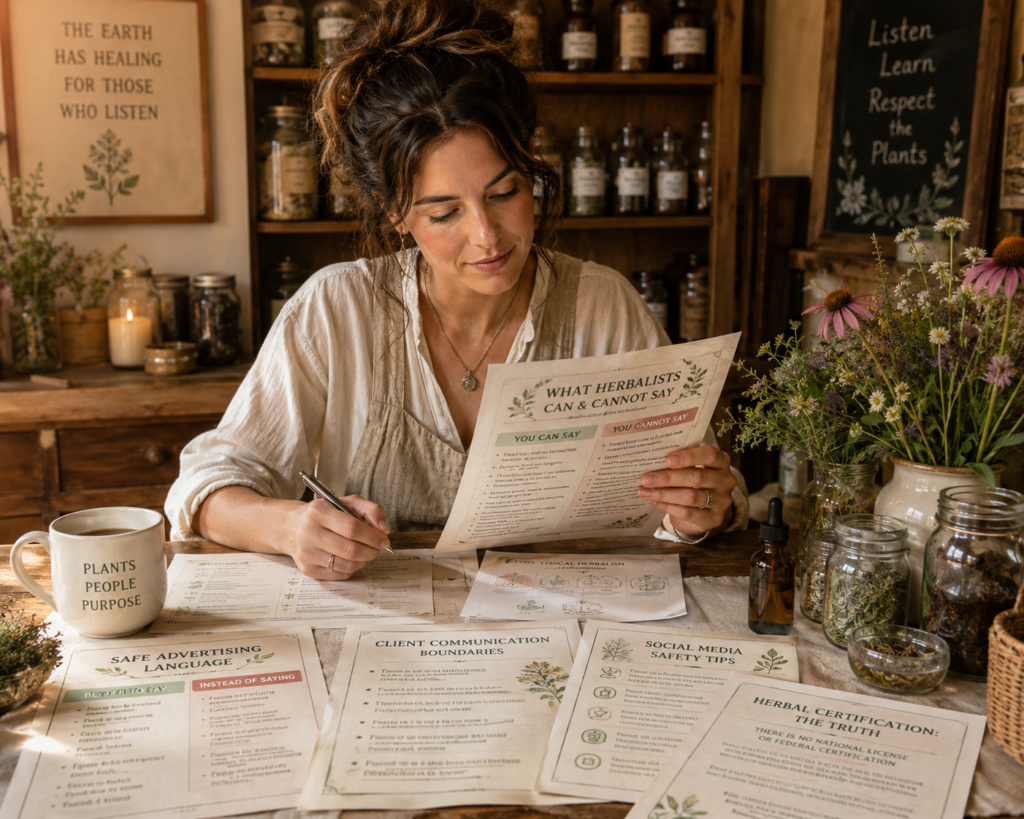
Image by Kathy McCabe & OpenAI
This is especially important in the United States, where herbs sold as teas, tinctures, capsules, powders, salves, or similar preparations may fall under food, cosmetic, or dietary supplement rules depending on how they are marketed. The words we use matter.
First: Herbalists Are Not Nationally Licensed in the U.S.
There is currently no single national license or federal certification for herbalists in the United States. A person may complete an herbal school program and receive a certificate of completion. They may also join a professional organization or apply for a peer-reviewed professional designation, such as Registered Herbalist membership through the American Herbalists Guild. But these are not the same as a state medical license, nursing license, dietitian license, or other government-regulated healthcare credential. (americanherbalistsguild.com)
This does not mean herbalists are untrained. Many herbalists study for years, complete clinical programs, apprentice, conduct research, and maintain strong ethical standards. It simply means that “certified herbalist” can be a confusing phrase. In most cases, it means the person completed a school’s certificate program, not that they hold a nationally recognized government certification.
A safer way to say it is:
“I completed herbal studies through ___.”
“I hold a certificate in herbalism from ___.”
“I am a member of ___.”
“I am a Registered Herbalist with the American Herbalists Guild,” if applicable.
Avoid implying that you are nationally licensed, medically certified, or government-approved unless you truly hold a regulated credential that allows that wording.
The Big Rule: Do Not Make Disease Claims
For herbal products, one of the biggest red flags is claiming that a product can diagnose, treat, cure, prevent, or mitigate a disease. The FDA distinguishes between disease claims and structure/function claims. Structure/function claims may describe how a nutrient or dietary ingredient supports normal body structure or function, such as “supports digestion” or “helps maintain normal bowel regularity.” Disease claims, such as “treats IBS,” “cures anxiety,” “lowers high blood pressure,” or “prevents colds,” are much more legally risky and may cause the product to be treated as an unapproved drug. (U.S. Food and Drug Administration)
Instead of saying:
“This tincture treats anxiety.”
Say:
“This blend is traditionally used to support relaxation and a calm nervous system.”
Instead of:
“This tea cures acid reflux.”
Say:
“This tea was formulated to support gentle digestion after meals.”
Instead of:
“This salve treats arthritis pain.”
Say:
“This salve is traditionally used for comfort, massage, and supporting tired muscles and joints.”
The safer language stays in the realm of support, nourishment, comfort, normal function, tradition, and education.
Advertising Must Be Truthful and Supported
The FTC oversees advertising and marketing claims. Its guidance says health-related product claims must be truthful, not misleading, and supported by competent and reliable scientific evidence. This applies not only to labels but also to websites, social media posts, testimonials, emails, videos, and other marketing materials. (Federal Trade Commission)
That means herbalists should be careful with phrases like:
“clinically proven”
“guaranteed results”
“works for everyone”
“doctor recommended”
“replaces medication”
“safe for all ages”
“no side effects”
Those claims require strong evidence and may still be risky depending on the context.
What Herbalists Can Say With Clients
In one-on-one client work, herbalists can usually speak more educationally, but they still need boundaries. A good herbalist does not diagnose a medical condition unless they are also licensed to do so. They do not tell clients to stop medications. They do not present herbs as substitutes for necessary medical care.
Helpful client-friendly language includes:
“Have you discussed this symptom with your healthcare provider?”
“This herb has traditionally been used to support…”
“Let’s look at your constitution, habits, diet, stress, sleep, and overall patterns.”
“This is not a diagnosis, but these are areas we can support.”
“Please check with your doctor or pharmacist, especially because you are taking medication.”
“This herb may interact with certain medications.”
“Let’s keep your healthcare provider in the loop.”
This protects the client and the herbalist.
Product Language: Safer Phrases
For herbal products, safer marketing language often includes:
“supports relaxation”
“supports healthy digestion”
“traditionally used for seasonal wellness”
“supports respiratory comfort”
“supports normal elimination”
“supports a healthy stress response”
“helps maintain normal inflammatory response”
“supports restful sleep”
“supports skin comfort”
“crafted for massage and topical comfort”
“for occasional tension”
“for general wellness support”
These phrases are still claims, so they should be truthful, not exaggerated, and supported by appropriate evidence or traditional-use context.
Product Language to Avoid
Avoid claims such as:
“treats anxiety”
“cures insomnia”
“prevents flu”
“heals eczema”
“lowers blood pressure”
“reverses diabetes”
“kills viruses”
“anti-cancer”
“treats Lyme disease”
“works like Ozempic”
“natural antibiotic”
“replaces your prescription”
Even if an herb has promising research, these phrases can cross into disease-claim territory.
The Required FDA Disclaimer
For dietary supplements using structure/function claims, the familiar DSHEA disclaimer is generally required:
“These statements have not been evaluated by the Food and Drug Administration. This product is not intended to diagnose, treat, cure, or prevent any disease.”
The FDA also states that firms making certain structure/function claims in dietary supplement labeling must notify FDA within 30 days after first marketing the product with that claim. (U.S. Food and Drug Administration)
Be Careful With Testimonials
Testimonials can create claims, too. If a customer says, “This tincture cured my migraines,” and you use that quote in your marketing, regulators may view it as your claim. The same applies to comments, reviews, before-and-after posts, influencer content, and social media shares.
A safer approach is to avoid reposting disease-cure testimonials. Keep testimonials focused on taste, experience, routine, comfort, or general wellness.
Good Herbal Practice Is Also Ethical Practice
The safest language is not just about regulation. It is also about respect. Herbalists can educate, support, and empower people without overpromising. Plants can be powerful allies, but they are not magic bullets, and they are not always appropriate for every person.
Ethical herbal communication includes:
clear scope of practice
honest education
safety notes
medication interaction cautions
pregnancy and nursing cautions
referrals when needed
no exaggerated promises
no fear-based marketing
Bottom Line
Herbalists can say a lot. They can teach about traditional uses, body systems, wellness support, taste, energetics, preparation methods, and safe home use. They can help clients think through patterns and lifestyle support. They can create beautiful, thoughtful products.
But they should avoid diagnosing, prescribing, or claiming that an herb or product treats, cures, prevents, or reverses disease unless they are operating under an appropriate licensed medical scope.
And when it comes to “certification,” the truth is simple: herbalists may hold certificates, memberships, and professional registrations, but there is no single national U.S. herbalist license or federal certification.
The best path is honest wording, good training, careful documentation, and respect for both tradition and modern safety.
Disclaimer: This article is for educational purposes only and is not legal or medical advice. Herbalists and herbal product makers should check current federal, state, and local rules and consult a qualified attorney or regulatory specialist when needed.
Download the Herbalist Legal Marketing Information Sheets
Kathy is an herbalist/naturopathy practitioner who is constantly researching to expand her knowledge. She came to herbalism after her migraine medicine was suddenly removed from the market and she had to find something new. After discovering the magic of herbs she’s never looked back. She is accredited by the International Practitioners of Holistic Medicine (IPHM) View her courses of study.
This is a wonderful post, thanks so much for putting this together! I’ve been reading up on similar topics recently and found your insights to be spot on. Looking forward to reading more of your content!
Thank you for sharing this beautiful and informative article! I really appreciate the detailed write-up. It’s incredibly helpful for my research and daily workflow. Keep up the amazing work!
Thank you for sharing this beautiful and informative article! I really appreciate the detailed write-up. It’s incredibly helpful for my research and daily workflow. Keep up the amazing work!
Thank you for writing this! Your posts are always so thought-provoking and well-written. It has given me plenty of new ideas to consider for my own work.